
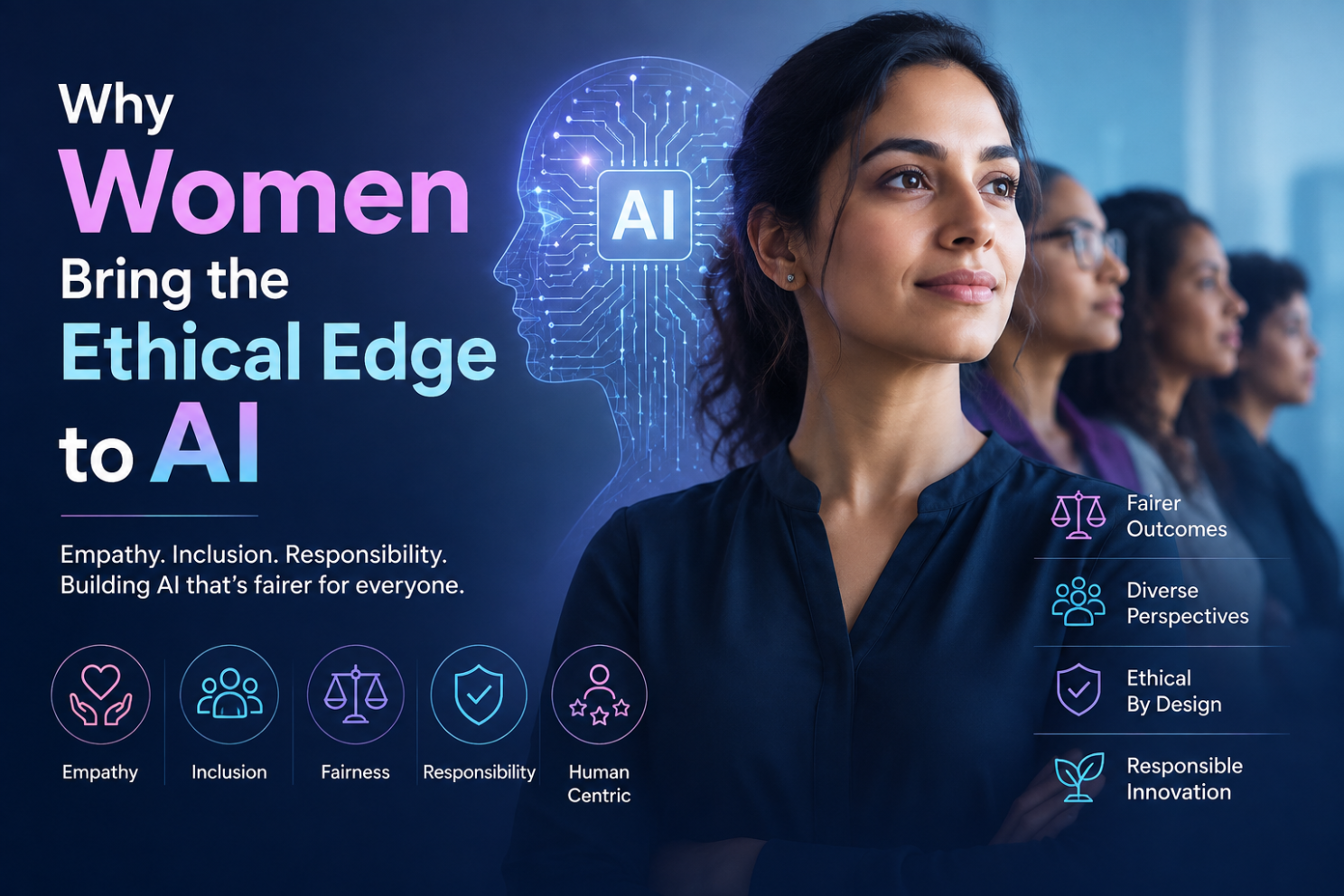
Why Women Bring the Ethical Edge to AI
Why Women Bring the Ethical Edge to AI
Artificial intelligence is moving rapidly from an experimental technology into an everyday companion at work, in education and in our personal lives. We ask AI to write, research, analyse, translate, summarise, code and increasingly to advise us. Much of the public conversation has focused on capability, productivity and the transformation of work.
Alongside these opportunities sits an equally important issue of responsibility. Every important technology creates ethical challenges alongside economic benefits. Artificial intelligence raises particularly difficult ones because it increasingly operates in areas once associated primarily with human judgement. It can influence writing, hiring, lending, education and healthcare, while also shaping how people interpret information, make decisions and assign responsibility.
These concerns are usually discussed in relation to regulators, ethicists and technology companies. Research into how men and women use generative AI introduces another dimension. Ethics may also influence willingness to adopt the technology. This matters because technological adoption is often measured through speed, with early adopters celebrated and hesitation treated as a weakness. Evidence around women and artificial intelligence suggests that caution can carry value of its own.
A major Harvard Business School study provides an important starting point. In the May 2026 revision of Global Evidence on Gender Gaps and Generative AI Over Time, Katelyn Cranney, Solène Delecourt and Rembrand Koning synthesised 76 sources from more than 100 countries. Among 318,924 respondents in sources reporting usage rates for both men and women, generative AI adoption was 47.8 per cent for men and 39.3 per cent for women, a relative gap of 22 per cent. The researchers found that the gap had narrowed over time but had stabilised at roughly 16 per cent since early 2025.1
The researchers also analysed global web traffic for the ten most visited AI tools and found a similar pattern. Women generally spent less time using AI, while gender differences were largest for frontier tools. Familiarity and exposure can narrow the gap as AI spreads, while organisational and social frictions can keep part of the difference in place.
Earlier Harvard Business School analysis helps explain those frictions. In a study involving about 17,000 entrepreneurs in Kenya, participants were given information about ChatGPT and an opportunity to use it. Women remained about 13 per cent less likely to try the technology, showing that equal access alone did not remove the gap.
Harvard’s accompanying analysis identified several possible influences, including differences in exposure, professional networks, familiarity with generative AI, confidence with unfamiliar technology and beliefs about whether using AI could be viewed as unethical or as cheating. Some women also worried that colleagues might judge their expertise more harshly if they relied on machine assistance. These findings do not establish that women are inherently more ethical. They show that concerns about appropriateness and professional judgement can affect adoption.
This changes the interpretation of the gender gap. Two employees can have identical access to an AI system and respond differently. One may immediately use it to research, analyse information and generate ideas. Another may spend more time considering organisational rules, confidentiality and personal responsibility for the final work. In an adoption survey, the second employee appears simply as the slower user, although the behaviour may also reflect conscientiousness.
Caution Can Be a Strength
Artificial intelligence rewards experimentation in ways that many earlier technologies did not. Generative AI usually requires little formal training before someone can begin using it productively. People learn through interaction, changing prompts, adding context and trying alternative approaches until they understand the technology and its limitations.
Frequent experimentation can build AI fluency quickly, giving confidence considerable professional value. Caution also has value because generative AI can produce convincing errors. Models can invent facts and citations, misunderstand instructions, reproduce bias and communicate uncertain information with excessive confidence.
A person who pauses to question an AI-generated answer may occasionally work more slowly than someone who accepts it immediately. In consequential situations, that scepticism can prevent a serious error. AI competence cannot be measured simply by frequency of use. Knowing when to distrust a machine is part of using one intelligently.
Greater caution among women should not automatically be classified as a deficit. Some behaviours that slow adoption may become increasingly valuable as artificial intelligence moves deeper into decisions affecting people, organisations and society.
Men Still Use AI More Intensively
The gender gap is changing as generative AI becomes mainstream. Pew Research Center’s 2026 survey of American adults found that men and women were now similarly likely to report using AI chatbots. Fifty per cent of men and 47 per cent of women said they used them, compared with 39 per cent and 28 per cent in 2024. Pew also found that 27 per cent of men used AI chatbots daily compared with 20 per cent of women.2
The distinction between adoption and intensity matters. Frequent users discover where models perform well, incorporate them into workflows and build familiarity through experience. Across several years, modest differences in use can become meaningful in speed and productivity. Harvard researchers have warned that persistent adoption gaps could affect career development if generative AI produces sustained productivity gains.
The Difference Begins Early
Differences in AI behaviour can also be observed before people enter established careers. Research from the Center for Digital Thriving at Harvard Graduate School of Education, developed with Hopelab and Common Sense Media, examined young Americans aged 14 to 22. It found that 53 per cent of men and boys had used generative AI compared with 48 per cent of women and girls, while 14 per cent of men and boys used it once or twice a week compared with 8 per cent of women and girls.
Differences also appeared in the purposes for which the technology was used. Among young users, 57 per cent of men and boys reported using generative AI to obtain information compared with 48 per cent of women and girls. For brainstorming, the figures were 58 per cent and 48 per cent. Coding showed a wider difference, with 20 per cent of men and boys reporting AI use for coding compared with 10 per cent of women and girls.
These numbers do not demonstrate that men are naturally more technical or more creative. Technology use develops within a social environment, and education, occupation, professional networks and previous exposure can all influence confidence with new technologies. Patterns of usage should not become assumptions about ability.
Women Express Greater Caution About AI
Attitudes towards artificial intelligence reveal another important gender difference. Pew Research Center reported in 2025 that 22 per cent of American men expected AI to have a positive effect on the United States over the following two decades, compared with 12 per cent of women. Among the AI experts Pew surveyed, 63 per cent of male experts expected a positive impact compared with 36 per cent of female experts.
The expert finding matters because technological unfamiliarity cannot fully explain the difference. Women with substantial knowledge of artificial intelligence can also hold more cautious views about its consequences. Pew also found that female AI experts were more likely than male experts to want greater control over how AI is used in their lives.
Such caution can represent a different assessment of technological risk. Artificial intelligence presents genuine concerns involving privacy, discrimination, misinformation, employment, intellectual property and the delegation of human judgement. Greater attention to these risks can reflect a stronger concern with the conditions under which innovation earns trust.
The Ethical Edge
This is where women can bring an important strength to artificial intelligence. The AI industry has devoted enormous resources to expanding what machines can accomplish. Greater capability creates a corresponding need for judgement about how those capabilities are used.
AI systems are moving into recruitment, credit decisions, education, healthcare and sensitive corporate work. Decisions in these areas carry consequences far beyond productivity. Responsible adoption requires people who examine accuracy, privacy, fairness and accountability before accepting technological convenience.
The ethical edge lies in recognising that speed alone is an incomplete measure of progress. Women who approach AI with greater caution contribute an important perspective to technological adoption, and their concerns can expose weaknesses that enthusiastic experimentation may overlook.
Caution should not become a reason for disengagement. Advanced AI skills develop partly through experience, and excessive hesitation can prevent users from acquiring the knowledge needed for informed judgement. Women should not have to choose between responsible behaviour and technological participation.
Organisations can remove much of that tension. Unclear rules can cause cautious employees to avoid AI, while poor governance can reward people who worry least about the risks and discourage those most attentive to responsibility.
The Call to Action
Closing the gender gap in artificial intelligence requires more than teaching women to write better prompts or encouraging higher usage statistics. Employers need clear rules explaining where AI can be used, when its involvement should be disclosed, what information must remain confidential and which outputs require human verification.
AI literacy programmes should move beyond demonstrations of productivity. People need to understand hallucinations, bias, privacy risks and the importance of verifying consequential claims. Schools and universities have an equally important role. Girls and boys need practical experience with AI alongside the ability to challenge its outputs and recognise its limitations. Confidence and critical judgement should develop together.
AI companies can contribute by building systems that make responsible behaviour easier through stronger privacy protection, clearer communication of uncertainty and greater transparency. Leadership teams should examine who participates in AI pilots, training programmes and governance discussions. A system shaped mainly by enthusiastic early adopters risks overlooking the concerns of people who approach technological change differently.
Women need a stronger presence in the engineering teams, executive committees, universities, regulatory institutions and corporate boards where the rules of the AI age are being established. Professional opportunity should not depend on a willingness to ignore legitimate concerns.
The gender debate around AI should move beyond counting how often men and women use the technology. The quality of engagement matters just as much. Artificial intelligence will be better served by people who combine experimentation with restraint, confidence with scrutiny and innovation with accountability.
Women can bring an ethical edge to AI when caution, questioning and responsibility accompany technological confidence. Turning that combination into greater participation, influence and opportunity should become part of the next phase of AI adoption.
Endnotes
Endnotes
1. Katelyn Cranney, Solène Delecourt and Rembrand Koning, Global Evidence on Gender Gaps and Generative AI Over Time, Harvard Business School Working Paper No. 25-023, May 2026.
2. Pew Research Center, The Gender Gap in AI,2026. The 2026 survey reports overall chatbot use of 50 per cent among men and 47 per cent among women, with daily use at 27 per cent and 20 per cent respectively.