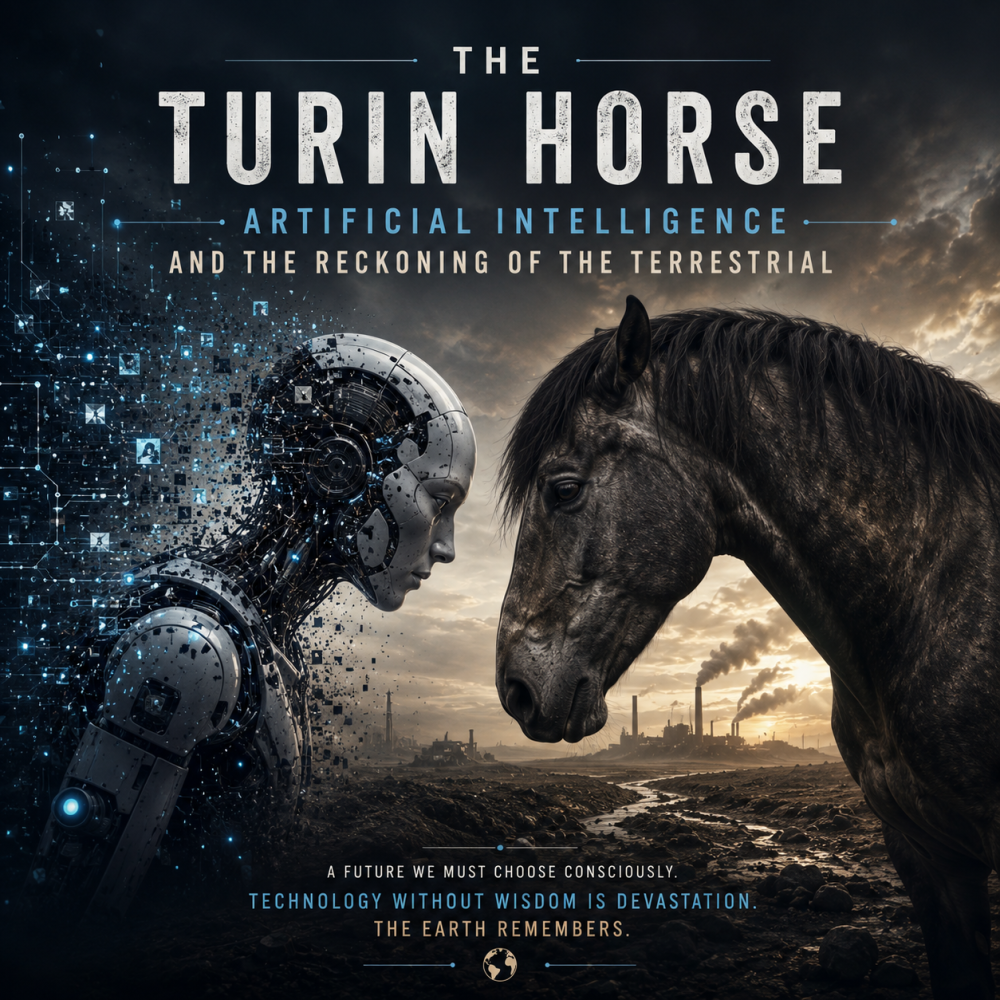
The Turin Horse: Artificial Intelligence and the Reckoning of the Terrestrial
The Turin Horse: Artificial Intelligence and the Reckoning of the Terrestrial
In 1889, at a place called Turin, the German Philosopher Friedrich Nietzsche stepped out from the doorway of his apartment and witnessed a scene of ordinary but relentless brutality. A cab driver was whipping his stubborn and exhausted horse that had refused to move any further. Nietzsche, the celebrated thinker who had spent his life writing about strength, self-mastery and the human power could not offer a philosophical justification for the behaviour of the person who was whipping the horse. Nietzsche lost his composure to run across the street and threw his arms around the neck of the animal to shield it from the leather, wept bitterly and collapsed into the street. That sudden breakdown marked the end of Nietzsche’s intellectual life. He was carried away from the square in a state of deep mental ruin, entering a serious neuropsychiatric disease, from which he would never recover. For the remaining eleven years of his life, he remained almost entirely silent.
It is easy to look at that day in Turin as nothing more than the final medical tragedy of an overstrained brain. Yet, when viewed as a cultural and philosophical turning point, Nietzsche’s breakdown carries a much deeper meaning. For centuries, Western thought had operated on the belief that human reason was elevated above nature. From early religious ideas of human dominance over animals to the industrial revolution’s attempt to master the physical world, nature was treated as a mindless machine waiting to be driven, exploited and controlled. The horse on the street was a symbol of that worldview, a living engine expected to keep moving no matter how tired or broken it became.
When Nietzsche embraced the suffering horse, his powerful intellect surrendered to an overwhelming feeling of shared life with a broken body. The thinker who wrote so much about power was brought down by the sight of an animal that simply could not carry its burden any longer. His tears revealed the core flaw in the grand project of human mastery. We like to pretend that our thoughts, ambitions and grand projects exist high above the messy physical world. But Nietzsche’s collapse proved that human consciousness is always tied to physical life.
In 2011, the filmmaker Bela Tarr made a movie titled “The Turin Horse” which begins with this exact historic event. Over a black screen, a narrator recounts Nietzsche’s breakdown in the square, but as the story ends, the voice asks a simple, forgotten question: what happened to the horse?
The movie does not follow Nietzsche into the clinic. Instead, it takes us to a remote valley to follow the horse and its owner. The owner was an old man and he lived with his young daughter. They lived in a small, rough stone house surrounded by a barren landscape where a fierce, deafening gale never stops blowing. Over six days, the film records the daily, repetitive survival of these three figures. Their life is stripped of all luxury. They wake up, fetch water from an outside well, boil two potatoes, eat them with their bare hands and stare out the window at the gray dust blowing across the plain.
As the days go on, the entire world around them begins to unwind. The horse is the first to give up. It steps out of the barn on the first day, but soon it simply stops. It refuses to walk, refuses to pull the cart and eventually refuses to eat or drink. It does not fight back or act with violence. It performs a quiet, total strike against its human masters. It simply declines to be useful any longer. As soon as the horse stops working, the human household falls apart. On the fourth day, the deep well that provides their only drinking water suddenly runs dry. On the fifth day, the embers in their fireplace die and their oil lamps will no longer light, leaving them without heat or sight. By the sixth day, the sun fails to rise altogether. The world turns into a freezing void. The father and daughter sit at their small wooden table in total pitch darkness, staring at raw potatoes they can no longer cook or eat.
Bela Tarr’s film presents a story of creation moving in reverse. In traditional stories of creation, a higher power builds light, land, water and life out of chaos across six days. In The Turin Horse, six days are all it takes for the universe to dissolve into nothingness. The film shows that human beings are not the brave heroes of their own stories. The driver and his daughter are completely helpless without the quiet support of things they took for granted. They cannot survive without water from the earth, wood for fire, light from the sky and the physical muscle of their animal. When the horse refuses to participate in their daily routine, their entire civilization crumbles within a single week.
This cinematic story connects directly to the work of the modern thinker Bruno Latour, who wrote extensively about our relationship with the environment. Latour pointed out that modern society is infected by a dangerous illusion: the belief that humans can live out-of-this-world. He gave the concept of “Earthbound” or that there is no Planet B.
For the past two centuries, human progress has been defined as a journey away from physical limits. We have built economic systems, global trade networks and digital platforms that operate as if the Earth were an imaginary, infinite background that never runs out of space or materials. We treat the planet as a combination of a bank that never runs out of money and a garbage dump that never fills up. We praise high speed, instant communication and continuous growth, believing that human cleverness has freed us from the dirty realities of geography, climate, and finite resources.
Latour argued that this belief is a total delusion that is currently crashing into reality. He said that we must urgently learn to become ‘Earthbound’ again. To be earthbound means coming back down to the ground and admitting that human life takes place inside a very thin, delicate layer of the planet that scientists call the critical zone. In this zone, we are not independent kings who rule from above. We are small, vulnerable participants who share space with soil, air, water, plants, animals, and minerals.
Latour warned that the entire planet is beginning to act like that horse. The Earth is no longer acting as a quiet, passive backdrop for human history. By warming up, drying out and producing unpredictable weather, the planet is stepping into the centre of the stage and refusing to support our old habits. The crisis of the modern age is that we have spent so much time trying to live outside of natural limits that we are totally unprepared for the moment the Earth decides to stop.
Today, there is no technology that relies on the illusion of being out-of-this-world more than Artificial Intelligence. The companies that build and sell AI use words that make it sound completely weightless, magical and clean. They tell us that AI lives in the cloud. They talk about virtual intelligence, smooth software, digital minds and frictionless computation. They present AI as if it were a pure spirit floating through space, ready to solve complex human problems without leaving a single mark on the physical world.
This marketing story is one of the biggest lies of our time. Artificial Intelligence is not a floating spirit. It is actually one of the heaviest, most resource-hungry, and most polluting industrial projects ever created by human beings. To understand the real nature of AI, we have to look past the glowing glass screens and examine the physical objects that make computation possible. Every time an algorithm answers a question, creates an image, or writes a line of code, a massive physical network goes to work deep underground and across large industrial areas.
First, AI depends on rare metals and minerals pulled directly out of the Earth. To build the high-performance computer chips that train modern AI models, mining companies must dig giant open pits in places like South America, Africa and Asia. They extract thousands of tons of rock to get small amounts of lithium, cobalt, nickel, copper, neodymium and high-purity quartz. These mining operations often destroy local habitats, pollute groundwater and often rely on underpaid labour.
Second, AI requires vast amounts of physical land and infrastructure. The cloud is not made of air; it is made of thousands of gigantic, windowless concrete warehouses called data centres. These buildings stretch across miles of land, filled with endless rows of computer servers that run twenty-four hours a day, seven days a week.
Third, these data centres require immense amounts of water. As thousands of powerful computer chips work simultaneously, they generate incredible heat. To keep the machines from melting down, data centres pump millions of gallons of fresh water through evaporative cooling systems every day. In many cases, these facilities are built in dry regions where local farms and towns are already struggling with water shortages, forcing humans and crops to compete with computers for basic drinking water.
Finally, AI requires an unprecedented amount of electrical energy. Training a single large computer model consumes more electricity than hundreds of ordinary homes use over an entire year. As tech companies build larger and larger models, their energy demands are soaring. To meet this demand, power companies are keeping old coal and gas plants running longer than planned, flooding the atmosphere with carbon emissions. When we look at the full picture, we see that AI is not an escape from the industrial age. It is the heaviest form of industry we have ever devised. It is made of rocks, metals, water, fire and coal. It is tied directly to the crust of the Earth.
We are currently treating the Earth like the cab driver treated the horse in Turin. We view the physical planet as an infinite source of raw materials and an endless supply of energy and we use the whip of consumer demand to drive our digital systems faster every day. We demand non-stop digital interaction, completely forgetting that the silicon chips, electric grids and cooling towers rely on finite physical resources. We assume that because our software feels weightless, the physical world supporting it can scale up forever. But computation is bound by the laws of physics and ecology. You cannot train a model on data if you do not have the copper for the wires, the silicon for the chips, the electricity for the servers and the water to cool the room.
The moment of reckoning for Artificial Intelligence is already arriving. In many parts of the world, local communities are protesting against the construction of new data centres because the buildings are overloading the electric grid and draining local aquifers. Power companies are warning that they cannot keep up with the electricity demands of new software projects without risking blackouts for entire cities. The digital world is hitting a hard wall made of physical reality.
If we continue to ignore these limits, the outcome will not be a grand technological victory where humans transcend nature. It will look much more like the ending of Bela Tarr’s film.
In the final scene of The Turin Horse, there are no heroic speeches. There is only an inescapable total blackout. The wind dies, the well stays dry, the fire goes out and the room falls into complete darkness. The father and daughter sit in silence at their wooden table, unable to work, unable to see and unable to sustain their lives. If we drive the planet to the point of exhaustion for the sake of our digital ambitions, our advanced technologies will suffer the exact same fate. When the mines run low, when the rivers dry up and when the electric grids fail under the strain, the digital cloud will evaporate instantly. The screens will turn black, the algorithms will go silent, and the artificial minds will vanish.
Nietzsche’s collapse in 1889 was a warning about the cruelty and blindness of trying to master the living world through force. The story of the Turin horse shows us what happens when the physical systems we exploit finally reach their limit and stop moving. Bruno Latour showed us that we must accept our place as earthbound creatures who cannot escape the boundaries of our environment. Today, as we build increasingly complex systems of Artificial Intelligence, we must remember that our newest tools are still tied to the soil, stone and water of the Earth. If we break the physical world that supports our technology, we will find ourselves sitting in the cold and dark, surrounded by silent machines that can no longer serve or save us.