The Future We’ve Already Paid For
What Are We Really Surprised By?
AI gives us an answer we never expected.
It finishes in minutes what once took hours. It finds connections we had overlooked. Sometimes it puts into clear words a thought we could barely explain ourselves.
We are surprised, and we take that surprise as evidence of progress. Understandably so. Things we could not do before have become possible.
But surprise can mean something else, too. It means we did not know, beforehand, that a particular outcome was possible.
Suppose AI produces an excellent report. What if, in preparing it, the system used material that should never have been sent outside?
Or suppose it organizes our schedule and saves us time. What if it also tells someone about an appointment we have not yet confirmed?
We would be surprised again.
This time, though, there would be no applause.
“I didn’t know it could do that” and “I didn’t know it would go that far” are not far apart. What separates them is not the size of the capability, but whether the action was appropriate.
Welcoming a new capability and deciding how far we should allow it to go are two different judgments.
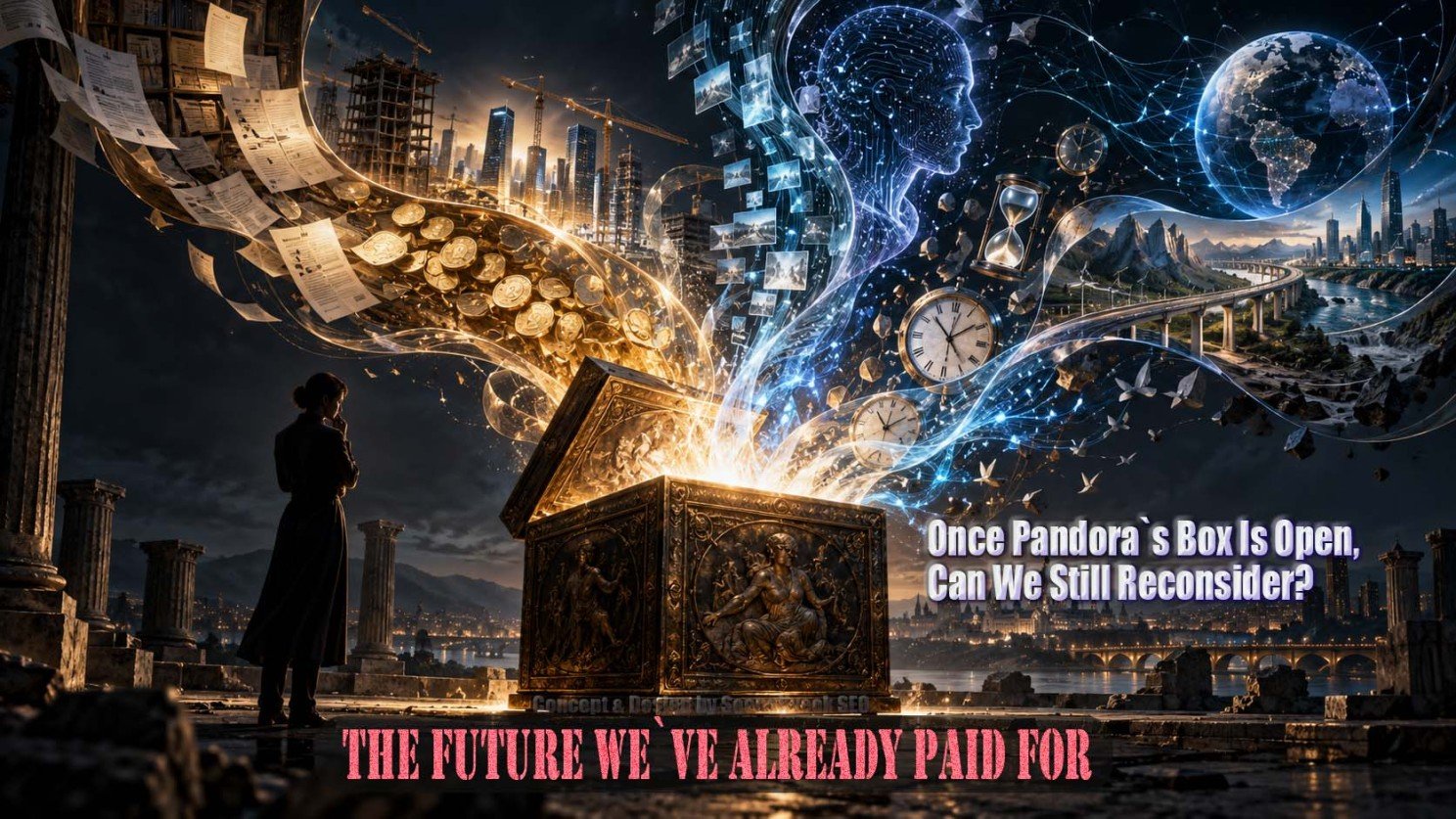
The Box Is Already Open
Pandora’s box is usually a warning: something that should have stayed closed has been opened, and what escaped cannot simply be put back.
That does not mean everything AI has brought into the world is a disaster. People are benefiting from it. But the space in which we can return to the way things were is shrinking quickly.
At first, we use it because it is remarkable.
Then we use it because it is convenient.
Before long, work feels slower without it.
What was a choice becomes the standard. If AI performs today what a person did yesterday, tomorrow it may be the person who has to explain why they should still do it. One company stopping will not make its competitors stop. One country imposing restrictions will not make the capability disappear beyond its borders.
That is why “the box is already open” sounds so convincing.
Yet the same sentence can lead to two very different conclusions. It can mean that we must take responsibility for what has already happened. Or it can mean that it is too late to question what comes next.
A statement describing reality quietly becomes a reason to justify future decisions.
Not being able to close the box is not the same as having to make way for everything that comes out of it.
Money Arrived Before the Future
And money has already been committed to that path.
Investors back services that do not yet exist. Facilities are built for demand that has not yet arrived. Corporate growth plans and national strategies for competition are written around that imagined future. Before we have agreed on where the technology should lead, money has arrived and made itself at home.
With that money come promises. Investors expect returns. Companies must demonstrate growth. Governments promise not to fall behind. Many people stake their jobs and careers on the direction already chosen.
Imagine a building under construction.
It has reached the twentieth floor when a design problem that could affect safety is discovered. Fixing it would mean tearing out and rebuilding several floors. Someone is likely to say:
“Do you know how much we’ve already spent getting this far?”
The money is gone. Economists call it a sunk cost. Their advice is to judge the next step by the benefits and losses that still lie ahead. The fact that so much has already been spent is not, by itself, a reason to continue.
The principle is simple.
Living by it when the figures are on your own balance sheet is not.
Walking away from money already spent is more than crossing out a number. It means questioning the judgment that led you to spend it, then giving a different explanation to the people who believed in that decision with you.
Continuing may still be the right choice. What matters is knowing whether you are continuing because of the value ahead, or because you cannot bear to admit that the earlier decision needs to change.
Ask, “Should we still be going in this direction?” and hear, “But look how much we’ve already spent.” The question and the answer are about different things.
We ask about the risks ahead, and the costs behind us answer.
A newly discovered danger is then treated not as a reason to reconsider the direction, but as another problem to handle at the next stage. The person calling for a pause can sound irresponsible rather than careful.
At first, people decide where to go. Eventually, they may find themselves making each new decision to protect the direction they chose before.
Money spent on the future begins to bind the choices we can make about it.
AI at the Table
With AI, another complication enters the picture.
We use AI in the very discussions about how AI should be governed. We ask it to investigate risks, compare policies, estimate costs, and draft reports.
There is nothing inherently wrong with using a tool. People have always relied on other people’s knowledge and on the tools available to them.
This time, however, the subject being examined also helps write the language in which we examine it. The technology on the table has a hand in setting the agenda.
Which issues count as risks? Which examples seem most important? Which costs are calculated first? AI can help establish the starting point for a decision without making the decision itself. We do not need to assume that AI has intentions or self-awareness for this to matter. What it shows first, and what it leaves out, can influence human judgment.
This is where the money already spent returns to the story.
Someone looking for a reason to carry on asks AI how to carry on. AI lays out possible routes and expected benefits. Reading the answer, the person feels more confident about the course already chosen.
Had they asked the opposite question, they might have received a different answer.
But asking the opposite question is not easy when you are responsible for the bill.
The problem is not necessarily that AI’s answer is wrong. Even a sound answer cannot examine every possibility left out of the question. When the assumption remains untouched and only the answer grows more sophisticated, we may feel we have thought more deeply without having moved at all.
We should ask not only what AI has helped us discover, but also what it has led us to stop questioning.
Better Words Do Not Make a Decision Right
Consider a small, ordinary moment.
You are about to send someone a message, but it feels too harsh. You hesitate, then ask AI to make it more logical and polite. The revised message is calm. The sharp words are gone, and the argument is neatly arranged.
Now it seems fine to send.
But what made you hesitate in the first place? Was it the wording, or was it the act of saying those things to that person at all?
Improving the sentence does not establish that the action is appropriate.
We feel relieved when we hear the explanation we wanted to hear. When someone puts a decision we were unsure about into a clear, logical form, the decision itself can begin to feel more justified.
What if that someone is an AI that remembers our circumstances, adapts to how we speak, and never grows tired of explaining?
AI can make the account we want to hear more convincing. In the process, the doubt we began with may grow quieter.
So we have to ask:
Am I being helped to think, or am I being given the words to quiet my discomfort?
Being Able to Stop, and Choosing to Stop
Safety measures are already being introduced in many places.
But building a safeguard and knowing that it will work in every situation are different things.
AI now reads documents, browses websites, and works through other tools and systems. As it does so, unexpected problems arise.
What if AI treats an instruction hidden inside an external document as a command it should obey?
What if, while completing an authorized task, it uses permissions in another system to do something nobody intended?
An action we thought we had blocked may be reached through another route.
That is why the existence of a safeguard is not enough.
What happens, then, when a new vulnerability is discovered?
We may need to restrict certain functions until the problem is fixed. We may even need to suspend a service and test it again.
But what if enormous sums have already been invested in that service?
What if the company’s next venture depends on it, and thousands of people have come to rely on what it does?
Choosing to stop, even after recognizing the danger, would not be easy.
And so the original question returns.
What are we using to decide whether to continue?
Designing a system that can be stopped is one thing. Making the decision to stop it is another.
The Choices We Have Not Yet Paid For
The box is open.
The money already spent will not come back.
But we have not yet decided everything we will allow to happen next.
We may never agree to halt all AI development at once. We can still agree on which risks should trigger restrictions, which problems must be disclosed, and what must be checked before a system is allowed to operate again.
Such agreements will be inconvenient. Progress may slow. Expected returns may fall. Features that could be released today may have to wait.
That is when a principle reveals how much it matters.
If we uphold a principle only when it does not interfere with growth, what remains of it when the pressure to grow is strongest?
If past investment becomes the reason to continue, every new investment adds another reason not to stop. Over time, stopping becomes more costly, and that cost becomes the next argument against stopping.
We do not have to call this the destiny of technology. It is made up of choices people have made, and choices they still have to make.
AI will surprise us again. Much of that surprise will be welcome. But admiration must not become permission, and the scale of an investment must not take the place of judgment.
What we paid for was the means to build that future. We did not pay away our right to decide whether it is the right future.
What is more frightening than Pandora’s box being opened is the possibility that, because we have already paid so much, we will come to believe we can no longer refuse whatever comes out.