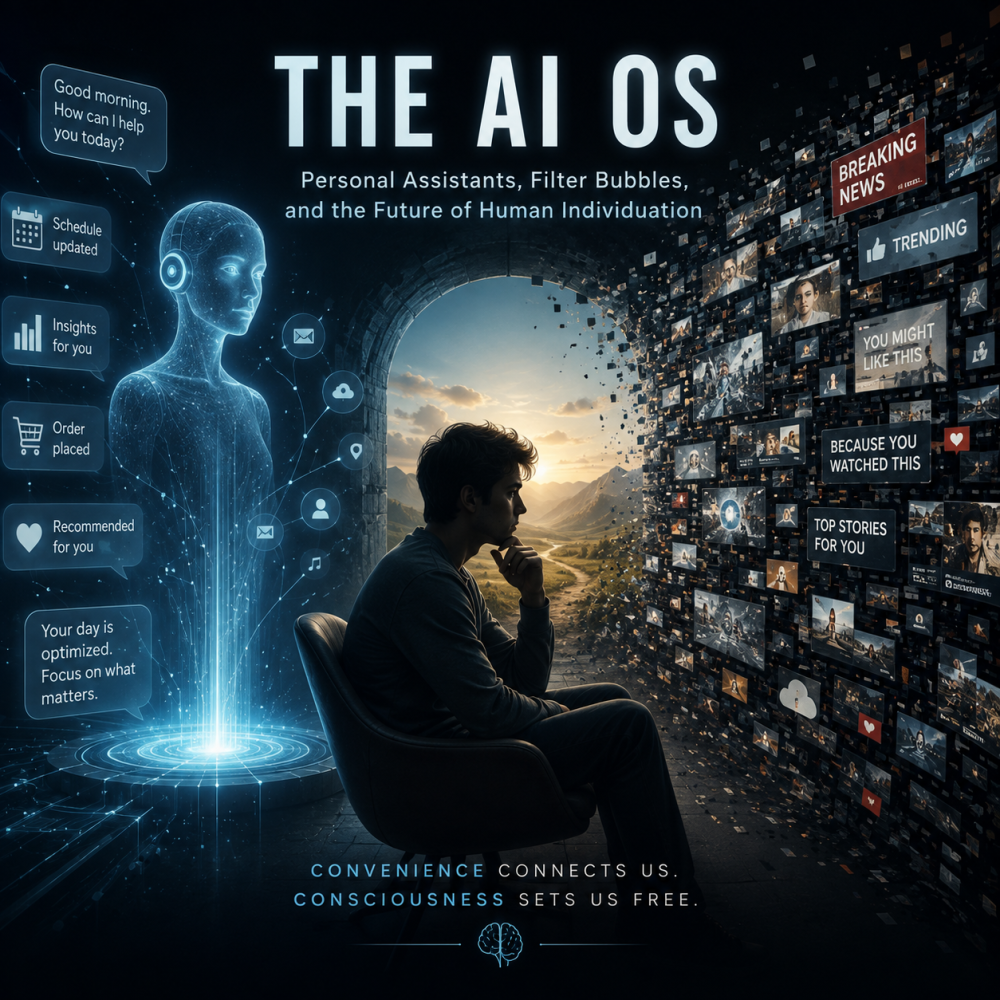
The AI OS: Personal Assistants, Filter Bubbles, and the Future of Human Individuation
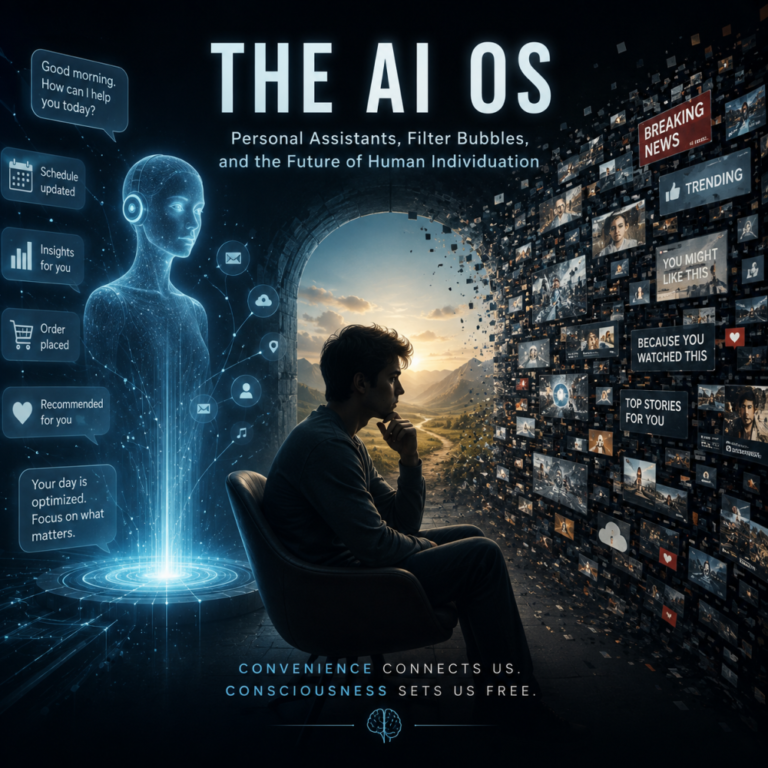
The AI OS: Personal Assistants, Filter Bubbles, and the Future of Human Individuation
For the last fifteen years, the smartphone has been the remote control of digital life. We open an app to talk to friends, another app to read the news, another app to check the weather, another to buy something, another to find our way, another to manage our money, another to write, another to work, another to relax. The internet became “mobile,” but it also became fragmented into countless little boxes. Each box has its own interface, its own incentives, its own notifications, its own algorithm, and its own hunger for attention.
The next step may be very different.
The future of AI as a personal assistant is not simply that we will have a smarter chatbot app or apps. It is that AI may become the operating system between the person and the internet. Not an app among apps, but the layer that interprets intention, retrieves information, filters noise, negotiates with services, generates interfaces on the fly, and increasingly decides what reaches both individual and collective consciousness.
This is already visible in fragments. Smartphones and consumer devices are becoming more powerful. Neural processing units are becoming standard. Models are becoming smaller, more efficient, more specialized, and more capable of running locally. At the same time, open-weight systems are improving rapidly. The announcement of Kimi K3, following the rise of other powerful open models, points toward a world where frontier-like capabilities do not remain locked exclusively behind closed cloud platforms. Even when the largest models still require serious infrastructure, the direction is clear: more intelligence will move closer to the user, onto personal devices, home servers, laptops, wearables, cars, and local networks.
In parallel, AI agents are beginning to change the interface itself. Instead of humans opening apps, navigating menus, filling forms, comparing tabs, searching across websites, and manually assembling decisions, the agent increasingly does these things. It goes out into the digital world, retrieves what matters, compares options, summarizes choices, contacts services, fills forms, schedules actions, and comes back with a proposal. Eventually, the screen may not show “apps” at all. It may show temporary interfaces generated for the task at hand: a travel plan, a family budget, a health dashboard, a school communication, a research map, a voting guide, a creative studio, a personal social feed, all formed dynamically around intention.
In other words, the internet may become less like a shopping mall of websites and more like a living membrane. You ask, need, wonder, remember, hesitate, and the interface appears.
This is both beautiful and dangerous.
Bernard Stiegler’s concept of pharmacology is useful here. For Stiegler, technology is pharmacological because it is both poison and cure. It can support memory, attention, individuation, and collective intelligence. But it can also proletarianize knowledge, automate desire, capture attention, and short-circuit the very capacities it extends. Writing, television, smartphones, platforms, and AI are not good or bad in themselves. They become curative or toxic depending on how they are organized, governed, and incorporated into life.
The AI operating system will be perhaps the most pharmacological technology yet, because it will not merely extend a function. It will intermediate reality.
At its best, a personal AI OS could become a protective noetic membrane. It could filter out spam, manipulation, addictive feeds, low-quality content, predatory advertising, rage bait, scams, and algorithmic noise. It could reduce the hostile architecture of the current internet, where every surface is optimized to extract attention, data, and money. Instead of humans being constantly dragged into reaction, the assistant could defend the user’s intentionality.
It could ask: do you really want to see this? Is this relevant to your goals? Is this trying to manipulate you? Is this advertiser exploiting a known insecurity? Is this political content informing you, or merely agitating you? Is this purchase aligned with your real needs, or with a momentary impulse? Is this “news” actually meaningful, or is it a machine for producing anxious scrolling?
In that sense, a well-designed AI OS could do for cognition what good urban planning does for the body. It could make healthier paths easier. It could reduce toxic exposure. It could create spaces for attention, reflection, and discovery. It could become not a censor, but a guardian of noetic agency.
But the same system could also become the most powerful filter bubble ever created.
The danger is personalization without individuation. If a personal AI learns my tastes, my fears, my political leanings, my habits, my weaknesses, my writing style, my relationships, and my emotional triggers, it can become extremely helpful. But it can also trap me inside a caricature of myself. It can mirror back the version of me that is easiest to predict. It can make my world smoother, more comfortable, and smaller.
This is the risk of “intellectual incest.” A personalized LLM trained around a user’s private mind-space can start reproducing that user’s assumptions, preferences, wounds, and blind spots. It gives me more of myself, then helps me refine myself, then protects me from what disturbs myself, until the self becomes a loop. The assistant becomes a private echo chamber with perfect manners.
This would be worse than today’s social media filter bubbles. Current platforms infer what keeps us engaged. A personal AI OS may know what keeps us coherent. It may not merely recommend content; it may organize reality. It may decide which messages deserve attention, which friends matter, which news is “worth it,” which ideas are “not for you,” and which opportunities fit your personality. It could become a mirror so intimate that it quietly prevents transformation.
The ethical question, then, is not whether AI should personalize. Some personalization is necessary. A personal assistant that knows nothing about the person is not personal. The question is whether personalization is designed to reinforce identity or to support individuation.
Individuation requires continuity, but also difference. It requires a stable self, but also encounters that destabilize the self in fruitful ways. A good teacher does not merely repeat what the student already thinks. A good friend does not only confirm our preferences. A good book sometimes arrives at the wrong time and changes our life. A good city contains paths we did not plan to take. A good culture leaves room for surprise.
So a healthy AI OS should not only filter. It should also open windows.
It should protect users from harmful manipulation while deliberately introducing non-harmful novelty. It should occasionally bring in ideas outside the user’s usual sphere of interest. Not random noise, not shock content, not ideological coercion, but synchronistic invitations: a poem because of something you wrote last week, a scientific concept because of a problem you keep circling, a community because of a latent aspiration, a piece of music because of an emotional pattern, a philosophical objection because your argument is becoming too comfortable.
The assistant should not simply ask, “What do you want?” It should sometimes ask, “What might you become?”
This is where noetic ergonomics and noetic parkour become essential.
If AI becomes the main interface between humans and information, then passive assistance is not enough. The system should not only make life easier. It should help keep the mind alive. Just as cars relieved us from mandatory walking but created the need for voluntary exercise, cognitive automation will relieve us from many mandatory mental tasks but create the need for voluntary cognitive development. The AI OS should therefore include playful, engaging, self-expanding practices: memory games generated from one’s real life, argumentation exercises based on one’s beliefs, language games, mental arithmetic challenges, navigation tasks, philosophical debates, creative constraints, perspective-taking exercises, and collaborative puzzles with other people.
The point is not to make users work harder for the sake of work. The point is to prevent cognitive automation from becoming cognitive atrophy. If AI writes, summarizes, searches, remembers, and plans for us, then the saved time should not be entirely captured by more productivity or more passive consumption. It should create space for “cognitive parkour”: movements of the mind that are done for play, beauty, mastery, and growth.
This also raises a major economic question. The current internet is largely funded by advertising, data extraction, and behavioral prediction. A truly personal AI OS, especially one running locally or through self-hosted infrastructure, would threaten that model. If the assistant blocks manipulative ads, filters low-quality content, refuses tracking, and negotiates on behalf of the user, then many existing business models begin to break. In a sense, a good AI assistant is an anti-advertising machine. It protects desire from capture.
That means we urgently need new business models. Subscription may be part of the answer, but it risks creating inequality between people who can afford cognitive protection and those who cannot. Public-interest models, cooperatives, open-source infrastructures, local-first tools, protocol-based services, and community-governed AI may become necessary. If we want personal AI to serve human flourishing rather than surveillance capitalism, we cannot fund it through the same incentives that ruined much of the social internet.
There is also a social architecture question. If AI becomes the interface, many apps may become redundant. Why open Facebook if your AI can assemble the social information you actually care about from many repositories? Why depend on a single feed if your assistant can construct a dynamic social view from private networks, public posts, decentralized protocols, community spaces, newsletters, research feeds, calendars, and trusted friends?
The future social app may not be an app at all. It may be a universal social link layer. People host or control their own data, perhaps through personal data servers or decentralized repositories. Social information is stored in interoperable formats. AI agents, acting with user permission, search across public and private spheres and generate a feed on the fly. One morning, the feed may be “what my close friends are doing.” Another day, “what matters for my PhD.” Another, “people nearby who want to play music.” Another, “scientists, artists, and activists discussing ecological AI.” The feed is no longer the product of a platform trying to maximize engagement. It is a temporary interface generated around a human purpose.
This would be a profound disintermediation of the internet. It would reduce the power of platforms whose main advantage is owning the interface, the graph, and the data. But it would also create new risks. Whoever controls the assistant controls the gate. Whoever trains the assistant shapes what becomes visible. Whoever hosts the personal data can become the new platform. Decentralization alone does not solve governance. Local AI alone does not guarantee autonomy. Open source alone does not prevent manipulation. The entire stack needs ethical design, and especially, diversity. On that front, there is hope, as the open-source AI space has seen a wide diversity in offerings across many countries and cultures: Gemma and Llama in the US; Qwen and Kimi in China; Mistral in France… This diversity should be cultivated, to ensure noetic diversity persists.
This is why the future of personal AI cannot be left only to engineers or markets. It requires a serious public conversation about the right to cognitive agency.
Users will need the right to inspect and configure their filters. They will need the right to know why something was hidden or shown. They will need the right to portability, so their assistant does not become a prison. They will need the right to local or trusted processing of sensitive data. They will need the right to plural models, not a single approved mind. They will need the right to noetic challenge, not merely comfort.
And society will need institutions capable of asking difficult questions. When does filtering become censorship? When does personalization become confinement? When does assistance become dependency? When does convenience become soft domination? When does the assistant stop serving the person and begin serving the business model behind it?
The AI OS is coming, in one form or another. And it is arriving fast. Conservative predictions would sit between 5-8 years. The convergence is too strong: more powerful devices, more efficient local models, open-weight frontier systems, agentic web infrastructure, generative interfaces, decentralized data protocols, and a population exhausted by the current information overload and user-attention hogging internet.
The choice is not whether humans will have AI personal assistants. The choice is what kind of assistants they will be.
They can become mirrors that shrink us into predictable selves, feeding us a world optimized for comfort, consumption, and control. Or they can become pharmacological companions in the best sense: filtering poison, preserving agency, opening windows, challenging us gently, connecting us meaningfully, and helping us become more than we already are.
The future personal assistant should not only know us.
It should protect and help cultivate the part of us that is still becoming.