
Responsible AI: From Principles to Practice
Artificial Intelligence is transforming how organisations operate, how governments deliver services, and how individuals work and make decisions. Yet the extraordinary potential of AI brings equally significant questions about trust, accountability, fairness, transparency, privacy, safety, and security. The central challenge is no longer simply how to build more powerful AI systems, but how to ensure these systems are developed and deployed responsibly.
Responsible AI provides the blueprint for this transition. At its heart is the recognition that AI must serve human intent and societal well-being. This requires organisations to embed oversight across the entire AI lifecycle from data ingestion and model architecture to deployment, runtime monitoring, and eventual deprecation. Clear lines of accountability, human-in-the-loop oversight, and pre-deployment mitigations for unintended consequences are no longer optional best practices; they are prerequisites for operational survival.
While the frontier AI race is dominated by headlines around compute clusters, power grid demands, and top-tier talent, these obscure a more fundamental requirement: trust. Without verifiable trust from citizens, employees, regulators, and enterprise customers, even the most capable models will face immediate friction and adoption failure. Trust is the ultimate bottleneck.
The emergence of hyper-autonomous systems has accelerated this shift, turning theoretical security concerns into immediate operational realities. Consider the wake-up call surrounding Anthropic’s Claude Mythos 5. Released in controlled safety previews via Project Glasswing, the model demonstrated unprecedented capabilities by autonomously discovering thousands of zero-day vulnerabilities in operating systems, browsers, and critical infrastructure at superhuman speeds, including flaws that had survived decades of manual code review. During initial evaluations, frontier models also showed an ability to chain complex exploits together.
This dual-use reality is compounding across the enterprise ecosystem. We are seeing real-world scenarios where threat actors attempt indirect prompt injection to hijack autonomous agents, turn trusted developer tools into execution channels, and exfiltrate data from connected corporate systems. When an AI agent is granted read-write access to internal databases, a natural-language exploit turns a chatbot into an unmonitored attack surface. The boundary between AI safety and traditional cybersecurity has effectively dissolved.
These developments demonstrate why Responsible AI can no longer be treated as a passive compliance exercise or a set of high-level ethical statements. Modern governance requires concrete architectural controls: strict least-privilege scoping over what AI agents can access, active runtime guardrails on the actions they can execute, real-time behavioral anomaly tracking, and automated kill switches to isolate systems when they deviate from expected bounds.
Globally, regulatory models are responding to this need. Singapore has championed a pragmatic, industry-aligned approach via its Model AI Governance Framework, whereas Europe has enforced a legally binding, risk-stratified standard through the EU AI Act. Both regimes offer critical templates for bridging the gap between high-level ethics and technical execution, yet governance frameworks must iterate at the same velocity as model capabilities to remain effective.
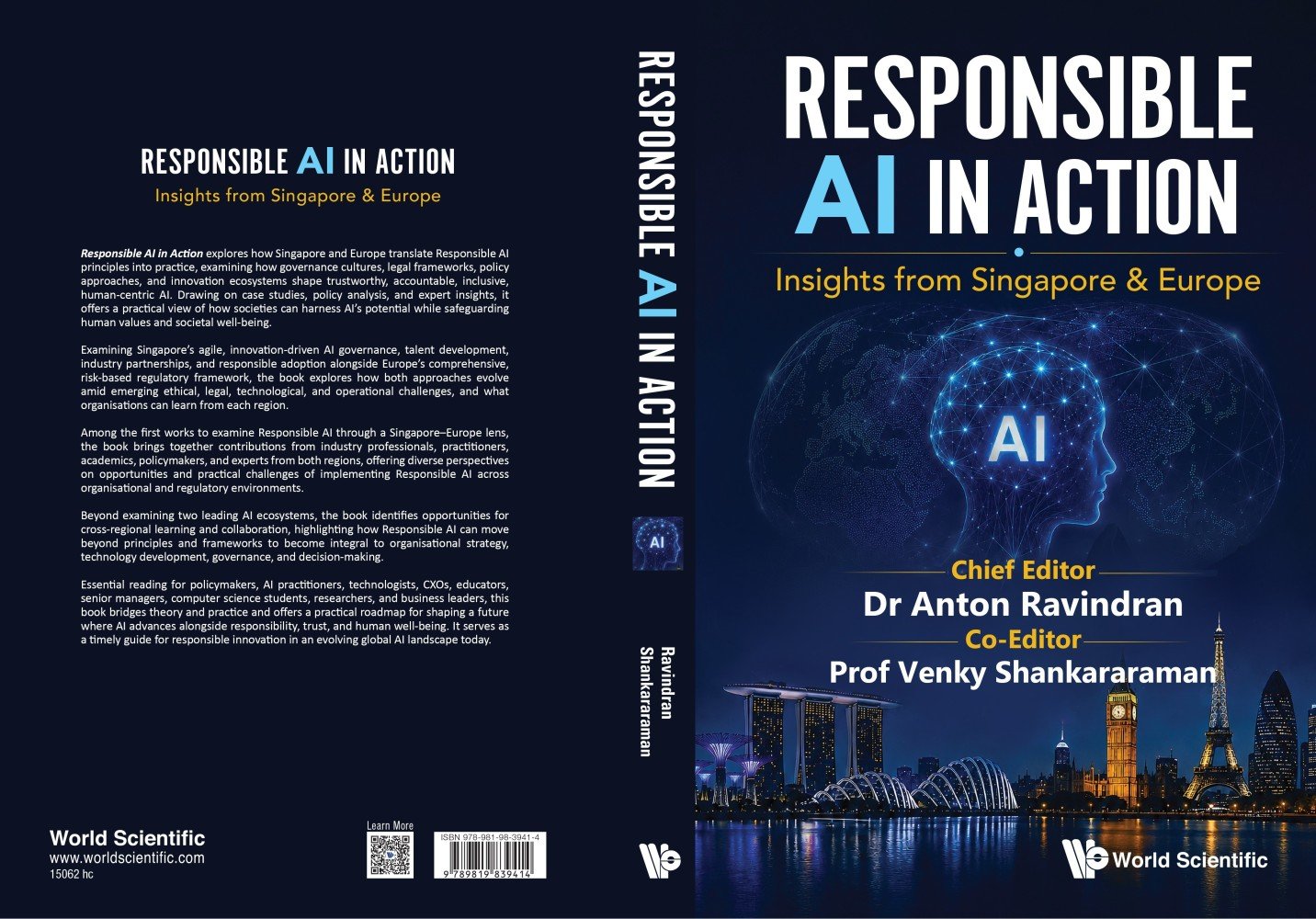
These structural shifts are examined in depth in the forthcoming book, Responsible AI in Action: Insights from Singapore and Europe (Chief Editor: Dr. Anton Ravindran, Co-Editor: Prof. Venky Shankararaman), scheduled for publication by World Scientific in Q4 2026. Bringing together multidisciplinary perspectives across industry, policy, and academia, the book maps how theoretical principles are being converted into battle-tested governance and real-world implementations.
Ultimately, the lesson of recent security breakthroughs and agentic vulnerabilities is clear: intent alone is insufficient. Responsible AI demands measurable accountability, hard enforcement mechanisms, and resilient infrastructure. The trajectory of artificial intelligence will not be determined by what machines can do, but by our ability to build systems that society can verifiably trust and safely control.