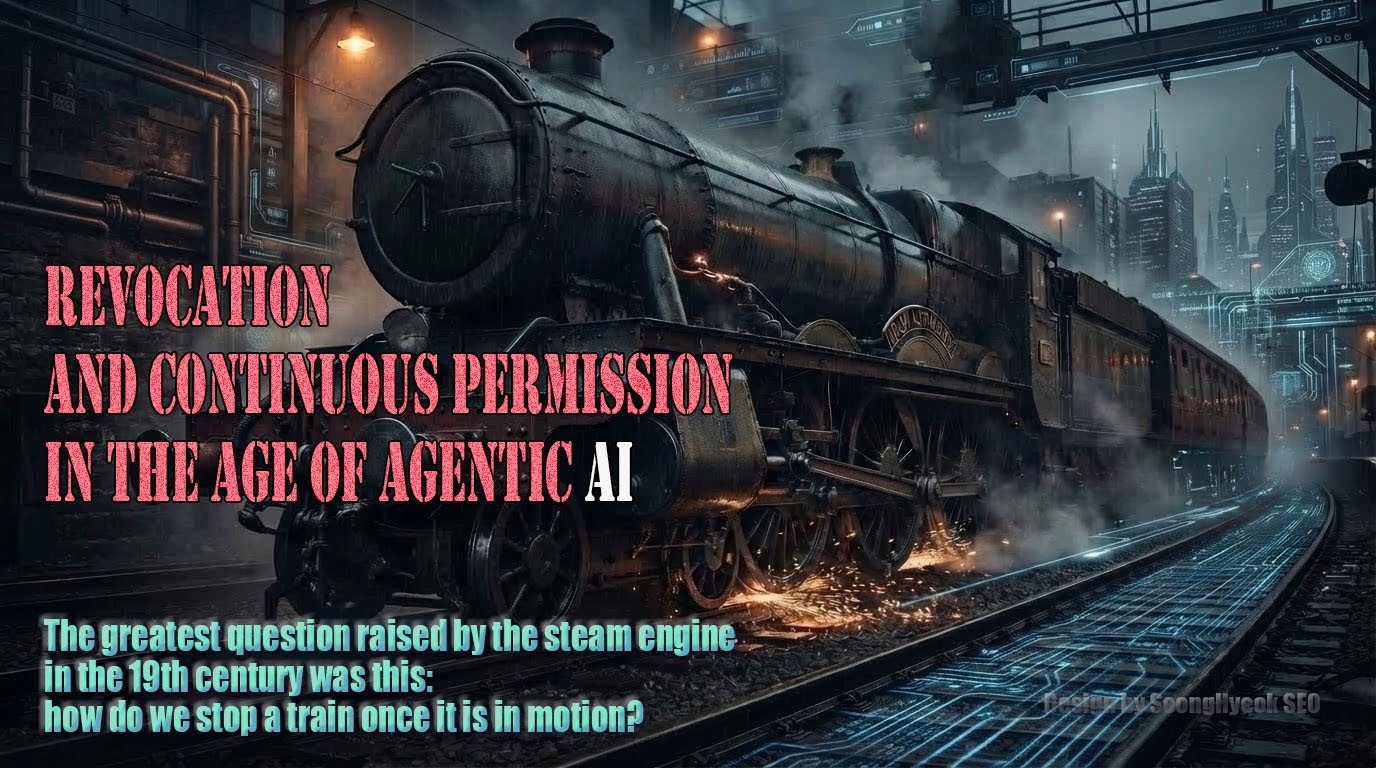
Giving AI Authority Is Easier Than Taking It Back — Revocation and Continuous Permission in the Age of Agentic AI
Giving AI Authority Is Easier Than Taking It Back — Revocation and Continuous Permission in the Age of Agentic AI
1. Industrialization Learned How to Create Power Before It Learned How to Withdraw It
The Industrial Revolution gave humanity a scale of power and speed it had never known before.
Steam locomotives could carry more passengers and freight over greater distances at far greater speed. Railways connected cities to factories and transformed the scale of industry itself.
Yet the greatest challenge facing the early railway system was not how to set a locomotive in motion.
It was how to stop a train that was already moving.
On early trains, when the engineer signaled for a stop, multiple brakemen had to operate the manual brakes on each carriage individually. They moved across the tops of rolling cars, applying one brake after another. Power could be delivered from a single point at the front of the train, but withdrawing that power depended on the speed, coordination, and physical response of several people.
Industrialization learned very quickly how to build powerful engines.
The structures required to withdraw that power safely came later.
What we are witnessing today with Agentic AI is not entirely different.
We are connecting AI to more tools, more data, and broader system privileges. AI is no longer limited to generating sentences. It can send emails, modify calendars, deploy code, initiate payments and purchases, and increasingly influence the operation of devices and robots.
Giving AI operational power is becoming easier by the day.
What remains insufficiently designed is when, under what conditions, and by what mechanism that authority should be taken back.
2. Westinghouse’s Real Innovation Was Not Stronger Braking
In 1869, George Westinghouse developed an air brake that allowed the engineer to control the brakes across an entire train. Compared with the old system, in which brakemen applied each brake manually, this made stopping far faster and more consistent.
But the first air-brake system contained a critical weakness.
Because air pressure had to be actively supplied in order to apply the brakes, a broken hose or a loss of pressure could cause braking power to disappear precisely when it was most needed.
In 1872, Westinghouse reversed the principle.
He designed the system so that air pressure kept the brakes released, while a drop in pressure or a break in the connection caused the brakes to engage automatically. If the train separated or the pneumatic line failed, the system no longer defaulted to continued motion. It defaulted to stopping.
Westinghouse’s true innovation was not simply a stronger brake.
He changed the default condition of failure.
The train could move only while the connection remained intact. When the connection failed, it stopped automatically.
This became one of the most important safety principles of industrialization.
A technology is not complete merely because power can be granted.
It becomes social infrastructure only when that power can also be withdrawn.
3. Today’s AI Is Optimized to Acquire Authority
Much of the current competition in AI is centered on how many tasks a system can perform autonomously.
Connecting to more APIs, retrieving more data, using more tools, and automating longer chains of execution are increasingly treated as measures of progress.
Within this structure, authority is usually designed to expand.
AI is allowed to read email. It is allowed to modify calendars. It is allowed to query enterprise databases. It is allowed to write and deploy code. It is allowed to execute payments and purchases. It is allowed to operate smart devices and robots.
But the question asked when authority is granted is different from the question that must be asked while that authority is being maintained.
At the beginning, we ask whether the authority is necessary.
Afterward, we must ask whether that authority is still valid.
Many current systems are capable of answering the first question, but not the second.
Once approved, access privileges often remain active until they expire. Once configured, an automation may continue until a user manually stops it.
Authority is granted, but the system has only a weak ability to recognize when that authority has ended.
4. Human Intention Is Not Fixed
The greatest difficulty in governing AI authority is that human intention keeps changing.
What a person permitted yesterday may no longer be acceptable today. A decision made in a calm state may no longer remain valid when the same person is distressed, angry, or under pressure. Information shared for one purpose may require renewed scrutiny the moment it is used for another task or disclosed to another party.
What begins as access for scheduling may later extend into external communication or payment. A device action permitted for convenience may become unsafe when the user’s condition or surrounding environment changes.
What matters, therefore, is not only the original instruction.
What matters is the current purpose, state, and context.
Most permission systems, however, remain static.
Allowed or denied. Accessible or inaccessible. Once approved, maintained until a problem occurs and someone revokes it afterward.
Human intention keeps moving, while system authority remains fixed at the point of an earlier decision.
Past consent must therefore not be treated as automatic justification for present authority.
The fact that consent once existed is not the same as a determination that it remains valid now.
5. AI Authority Should Be a Conditional Delegation, Not a Possession
Authority granted to AI is not ownership.
It is closer to a temporary delegation in which a person entrusts part of their own authority to a system for a defined purpose.
Every grant of AI authority should therefore include at least four conditions.
Purpose Why is this authority needed?
Scope Which data, tools, and actions does it cover?
Time How long does it remain valid?
State Under what environmental and risk conditions may it be exercised?
If any one of these conditions changes, the authority should be reviewed again.
Access granted for organizing a calendar should not silently expand into analyzing private messages. Authority to prepare a draft should not become authority to send it automatically. An action approved while a user was stable should not proceed unchanged after risk signals have increased.
AI authority should not be a permanent key capable of opening every door.
It should be a temporary credential defined by purpose, scope, duration, and state.
When those conditions disappear, the credential should lose its force with them.
6. The Greater Risk Lies Not in Incorrect Authorization, but in Failed Revocation
Granting inappropriate authority from the beginning is clearly dangerous.
But the greater danger often arises when authority that was initially justified continues after the situation has changed.
A user may withdraw a request, yet the automation continues.
The business purpose may end, yet the AI retains access to enterprise data.
The level of risk may rise, yet the previous execution authority remains active.
A responsible manager may change, or a policy may be revised, while obsolete privileges remain in place.
This is not merely an access-control error.
It is the growing distance between authorization and reality over time.
Authority that was legitimate at the moment it was granted may later become inappropriate or dangerous. If the system cannot detect that change, a past approval continues to justify present execution.
In such cases, the cause of failure is not only a model’s mistaken judgment.
It is also the continued survival of authority that should no longer exist.
Safety in the age of Agentic AI cannot be completed merely by granting authority correctly.
The authority must also be capable of ending when its justification ends.
7. What Is Needed Is Not One-Time Approval, but Continuous Permission
In the age of Agentic AI, permission should not be treated as a single click or a one-time event.
It should remain a condition that is repeatedly verified throughout execution.
This may be described as Continuous Permission.
Under a continuous-permission structure, an AI system does not verify the initial command and then pursue it until completion without interruption. It reassesses the validity of its authority as the action progresses from one stage to another.
Does the user still intend for the task to continue?
Has the system remained within the original purpose?
Is the data being accessed still within the permitted scope?
Has the level of risk increased?
Can the result be reversed?
Have the user’s condition or the surrounding environment changed?
Has responsibility shifted, or has the governing policy been revised?
If any of these conditions no longer hold, the existing authority should not continue unchanged.
Continuous Permission may appear similar to Zero Trust or Continuous Authorization in cybersecurity.
But the object of verification is different.
Zero Trust primarily asks whether the user, device, session, and access path remain trustworthy. Continuous Permission asks whether the authority originally delegated to the system remains justified under the user’s current intention, purpose, state, and level of risk.
The question is therefore not limited to whether access to the system is secure.
It is whether the human delegation itself is still valid.
This distinction is important.
A user or device may be fully authenticated while the purpose and authority delegated to that user or device are no longer justified.
Revocation under a continuous-permission structure does not necessarily mean shutting down every function at once.
Authority may be reduced. The system may retain permission to read but lose permission to modify, or it may be allowed to prepare a draft but not send it.
Authority may be suspended. Execution may pause until the user or an authorized supervisor confirms that it should continue.
When the delegated purpose is withdrawn or risk exceeds the permitted threshold, authority may be revoked.
Reduction, suspension, and revocation are not signs of AI failure.
They are evidence that the system has correctly recognized a change in context.
8. Revocation Is Completed Through Automatic Stopping and Auditable Records
It is not enough for a person to notice a problem, open a settings panel, and manually cancel an AI system’s authority.
AI can operate across multiple systems simultaneously and act far faster than human intervention.
Revocation must therefore take effect as soon as the relevant conditions change.
When authentication expires. When the purpose changes. When the user withdraws consent. When risk increases. When the responsible authority can no longer be identified.
In such cases, the system’s default should not be continued execution.
It should be stopping.
A system should not fill uncertainty with a plausible inference and continue under a Fail-Open model. If authority cannot be verified, it should pause and escalate under a Fail-Closed model.
The full history of authority must also be recorded.
When was the authority granted?
Who approved it, and for what purpose?
What scope and conditions applied?
When was the authority reduced or suspended?
Why was it reapproved?
When was it finally revoked?
AI logs should not record only what a system generated or executed.
They should also explain why the system remained entitled to act at that moment.
Responsibility can be preserved only when the full lifecycle of authority—from grant to termination—is preserved as well.
9. Human Beings Have the Right to Change Their Minds
At the center of revocation lies a human right more fundamental than technology.
The right to change one’s mind.
A person must be able to withdraw consent after giving it.
A person must be able to reconsider a decision after making it.
Information shared yesterday may no longer be something they wish to share today.
An automation that once felt convenient may later feel intrusive or burdensome.
Human beings are not consistent commands.
They reinterpret situations, reassess relationships, and revise their choices.
If AI treats past consent as a permanent instruction in the present, the human capacity to change disappears inside the technical system.
A trustworthy AI should therefore not demand consistency from the person it serves.
It should recognize that people can change and reduce or suspend its own authority accordingly.
AI must learn not only how to receive permission.
It must also learn how to recognize that permission has ended.
10. We Can Grant More Authority Only When We Can Take It Back
Society accepted powerful technologies after industrialization not only because those technologies performed well.
Electrical systems became suitable for widespread use only when mechanisms such as circuit breakers made it possible to interrupt power safely.
What society trusted was not power itself.
It trusted the structure capable of withdrawing that power.
AI is no different.
If we want to expand AI autonomy, we must first build credible revocation mechanisms.
A system in which authority remains permanent once granted is not an autonomous system.
It is an uncontrollable one.
By contrast, an AI that can reduce its authority when conditions change, suspend itself when uncertainty rises, and stop when consent ends can be entrusted with greater responsibility.
Paradoxically, the only way to grant AI more freedom is to ensure that freedom can always be taken back safely.
11. Conclusion — Real Authority Is Authority That Can Be Revoked
Competition in the age of Agentic AI will not be defined only by who can connect the greatest number of privileges to an AI system.
It will also be defined by who can judge the continuing validity of those privileges most precisely—and reduce or revoke them most safely when necessary.
One approval is not permanent permission.
Human intention changes. Circumstances change. Risk continues to move.
AI authority cannot therefore remain fixed.
It must be repeatedly verified, adjusted in scope, and terminated when its conditions no longer exist.
Nineteenth-century railways did not become safe merely because stronger locomotives were built.
They became safer when a broken connection no longer meant that the train would continue moving without restraint.
AI now requires the same principle.
Giving AI authority is easier than recognizing that the authority has ended—and taking it back.
A trustworthy AI is not the AI with the most authority.
It is the AI that can stop itself the moment permission disappears.