From Electricity to Intelligence, and Then to Conscience: Why AI Must Learn How to Be Ethically Self-Aware
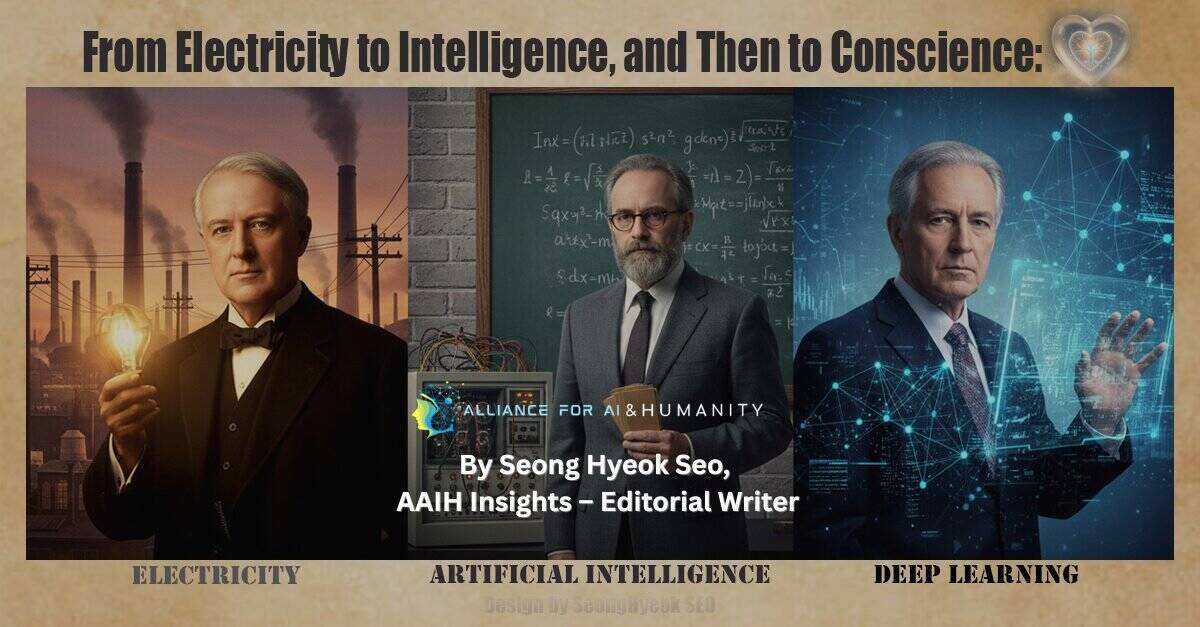
From Electricity to Intelligence, and Then to Conscience: Why AI Must Learn How to Be Ethically Self-Aware By:-
Seong Hyeok Seo( Fellow AAIH Insights – Editorial Writer )
The contents presented here are based on information provided by the authors and are intended for general informational purposes only. AAIH does not guarantee the accuracy, completeness, or reliability of the information. Views and opinions expressed are those of the authors and do not necessarily reflect our position or opinions. AAIH assumes no responsibility or liability for any errors or omissions in the content. In 1879, when Edison first brought light to the world, humanity escaped from darkness — yet people initially thought it was merely a brighter candle. It took a century before that light truly became part of the order of society.
If we look closely, the process of “making light work” was far from simple.
Cities had to dig up gas-lit streets, bury endless cables,
and rebuild every home and factory under new electrical standards.
Only after the first fires, electrocutions, and massive blackouts
did we invent circuit breakers, safety codes, and legal frameworks.
That was humanity’s first experience of Reactive Ethics —
a morality that arises only after accidents occur.
Soon we realized that electricity was not a single invention,
but the reprogramming of civilization’s entire operating system.
AI’s journey mirrors this almost perfectly.
Since the 1950s, artificial intelligence existed only as an idea —
a distant possibility suspended in theory.
But the moment AI began to learn by itself,
its speed accelerated beyond the reach of human control.
Now we live in a reality where that idea acts and judges on its own.
If electricity reshaped the physical world,
AI is reshaping the world of perception —
and this acceleration of perception is now transforming the physical world even faster.
What took electricity a century to standardize,
AI has spread across the globe in barely a decade.
The question is no longer what AI can do,
but how fast the next transformation will unfold.
The problem is that speed has outpaced ethics.
While our social, legal, and moral frameworks are still debating definitions,
AI has already redefined reality.
Its generations evolve yearly,
yet the structures designed to supervise or hold it accountable remain static.
Law is procedural; technology is exponential.
By the time we legislate one problem,
the algorithm that caused it has already been replaced.
Like the reactive model of the electrical age,
a regulation-centered approach can no longer match the real-time evolution of intelligent systems.
Ethics that intervene after an incident no longer work
in an age where accidents are computed in milliseconds.
In the era of electricity, the threat was physical shock.
In the era of AI, the shocks are data overloads and emotional fires.
Technology has grown ever smarter,
but human institutions still move reactively — always one step behind.
It is time to fundamentally rethink what safety means.
The answer no longer lies solely in external frameworks of law and regulation.
Yet depending entirely on ethics embedded inside AI systems is equally dangerous,
for that would risk creating opaque private codes —
exclusive moral architectures written by a handful of corporations,
turning ethics itself into another form of monopoly.
As we approach the era of AGI,
we must move beyond both of these extremes
and design a public, mutually accountable system —
one built on transparency, shared oversight, and collective understanding.
True Responsible AI is not about machines that simply obey human law;
it is about systems that, when confronted with ethical dilemmas,
can self-regulate and self-reflect according to a shared ethical consensus.
If law represents the minimal external rule,
then this shared awareness becomes our collective social conscience.
Just as electricity became a universal light
only after safety standards were established,
AI will earn humanity’s trust only when it runs
on a new operating system of ethical self-awareness.
Electricity once gave us light;
now AI must give us responsibility.
Progress is not about slowing technology down,
but about raising the speed of ethics to match the speed of innovation.
The age of light illuminated humanity only after safety;
the age of AI will shine with trust only when it builds its conscience.
Author – SeongHyeok Seo , AAIH Insights – Editorial Writer