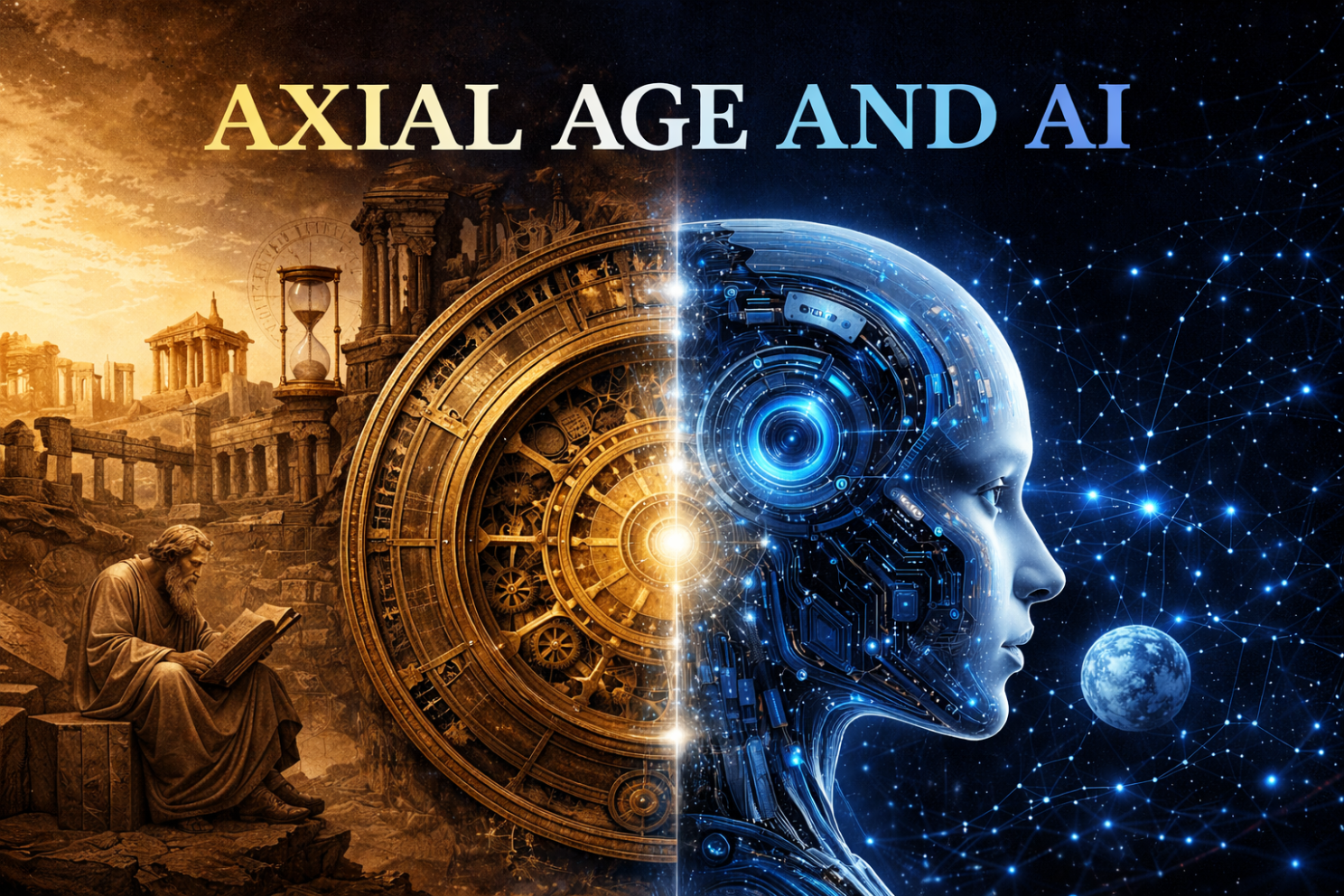
AXIAL AGE AND AI
AXIAL AGE AND AI By:
Martin Schmalzried , AAIH Insights – Editorial Writer
Around the middle of the first millennium BCE, something extraordinary happened across distant civilizations that had no direct contact with one another. This period is known as the Axial age. In Axial Age, as described by Karl Jaspers, human consciousness appeared to pivot. In Greece, thinkers like Socrates, Plato and Aristotle began to ask questions that still structure Western thought. They asked questions around justice, truth and the good life. These were not questions about survival or governance but they were meta questions. These were questions about the nature of reality itself. In India, the Upanishads emerged, shifting focus from ritual to introspection. Gautama Buddha rejected inherited authority and asked individuals to examine suffering through direct experience.
In China, Confucius emphasized on social harmony and ethics. In Persia, Zoroaster introduced a cosmic moral dualism between good and evil. Prophetic traditions reframed morality as a covenant between humans and a transcendent God. Across these geographies, a shared shift occurred. Humanity moved from myth to reflection, from ritual to reasoning and from obedience to inquiry. This was the beauty of the Axial Age as it was about cognition. It marked the first-time, humans systematically stepped outside their own beliefs and examined them. This was the birth of philosophy, ethics, and self-awareness and the emergence of what we might now call “second-order thinking.” Before this period, humans lived inside narratives; after it, they began to question them.
This transition is profound. It is the difference between using a tool and understanding why we are using a tool. It is the difference between believing a story and asking who wrote it and why. The Axial thinkers did not simply provide answers but they created frameworks for asking questions. Socrates did not claim knowledge but exposed ignorance. His method, later called the Socratic method, was less about arriving at conclusions and more about destabilizing certainty. Plato imagined ideal forms beyond physical reality. Aristotle categorized knowledge into logic, ethics, metaphysics and politics, effectively building the first intellectual operating system of the Western world.
In India, the Upanishadic idea of “Atman is Brahman” collapsed the distinction between self and universe. Buddha introduced the concept of impermanence and the illusion of a fixed self. Laozi emphasized non-action, or wu wei, as a form of alignment with natural order. These were not isolated doctrines but parallel attempts to grapple with the realization that human perception is limited and that truth is complex. The Axial Age represents the moment humanity discovered its own mind.
But it also introduced a tension that has never been resolved.
The tension was that if humans can question everything, then what remains certain. If morality is examined, does it weaken or strengthen it and If authority is challenged, what replaces it. In that sense the Axial Age did not end ambiguity but re-created it in a different form. And yet, it also created resilience. Systems of thought that could evolve, adapt and survive across millennia. Religions became philosophies and philosophies became institutions. Institutions were sustainable and became civilizations.
The impact of the Axial age was deep. The ideas of Socrates influenced Roman law. The teachings of Confucius shaped Chinese bureaucracy for centuries. Buddhist principles spread across Asia. The Upanishads shaped Hindu philosophy and the prophetic traditions influenced Abrahamic religions. The Axial Age also marked a decentralization of truth. Knowledge was no longer monopolized by priests or kings. Individuals could seek it, question it and interpret it. This democratization of thought was revolutionary.
Yet, it came with a cost.
Once humans learned to question, they could no longer return to innocence. This is the paradox of the Axial Age. It elevated human consciousness, but it also fragmented it. It gave us philosophy, but also endless disagreement. Ethics also ended in moral conflict and Religion created religious wars. Still, the Axial Age remains the foundation of modern civilization. Our legal systems, educational institutions, political theories and moral frameworks all trace back to this period. Even when we reject these ideas, we do so within the language they created. The Axial Age was not a moment in time. It was a permanent upgrade to human cognition and taught us how to think about thinking.
If the Axial Age was the moment humans discovered their own minds, then Artificial Intelligence may represent the moment we attempt to recreate that discovery outside ourselves. Artificial Intelligence is often framed as a technological revolution. It is conceived as faster computation, better predictions and automation of tasks, but this framing is incomplete. At its core, AI is not about machines doing things. It is about machines representing knowledge by learning patterns and making decisions. And it is expected that AI can reason about its own reasoning. This is where the parallel with the Axial Age becomes interesting. The Axial Age introduced meta cognition which is the ability to step outside one’s own thoughts and examine them. Modern AI systems are beginning to exhibit early forms of this capability.
Consider large language models. They do not merely retrieve information. They generate it and simulate reasoning. They can explain their answers, critique them and refine them. In architectures involving reinforcement learning, models evaluate outcomes and adjust strategies. In retrieval augmented systems, models combine internal representations with external knowledge. In emerging agentic frameworks, AI systems plan, act, observe and iterate. These are not static tools but dynamic processes. We are moving from tools that execute instructions to systems that interpret goals. We have already moved from deterministic machines to probabilistic agents and we are moving from computation to cognition. In a sense, we are building artificial participants in the epistemological project that began during the Axial Age.
But there is a critical difference?
The Axial thinkers were constrained by human experience. AI is not. An AI system can process vast amounts of data across domains. It can identify patterns that no individual human could perceive. It can operate at scales and speeds that fundamentally alter the nature of decision making. This creates both opportunity and risk. On one hand, AI can augment human cognition. It can help us navigate complexity, generate insights and explore ideas beyond our immediate intuition. On the other hand, it can destabilize the very frameworks the Axial Age created.
If machines can generate arguments, what happens to philosophy. If they can model ethical dilemmas, what happens to morality. If they can simulate belief systems, what happens to religion. We may be entering a second axial moment which is not defined by human introspection, but by externalized cognition. We are entering a world where thinking itself becomes a shared space between humans and machines.
This raises profound questions.
Who owns knowledge when it is generated by AI? What does authorship mean when ideas are co-created? How do we assign responsibility when decisions are made by systems that learn and evolve?
These are the questions of the Axial Age where the axial thinkers challenged the essence of truth, agency and the good life. The difference is that we are no longer asking these questions alone. AI introduces a new kind of actor into the epistemological landscape. This actor is not conscious in the human sense. It is not moral in the traditional sense. But it is capable of influencing both knowledge and action. These challenges existing frameworks of governance and ethics.
Traditional systems assume human intention. AI systems operate on optimization functions. They do not “intend” in the way humans do. They optimize based on objectives, data and constraints. This creates a gap between action and accountability. Bridging this gap requires new forms of governance. Not restrictions on autonomy alone, but design principles that embed alignment, transparency and adaptability into AI systems. In this sense, the debate around AI autonomy mirrors the tensions of the Axial Age. How much freedom should a system have? How do we ensure that freedom does not lead to harm? How do we balance control with innovation?
The answer may lie in a layered approach.
Just as the Axial Age produced multiple philosophical traditions, AI governance may require multiple layers of technical safeguards, Institutional oversight and Cultural norms. No single framework will suffice. Another parallel lies in the decentralization of knowledge. The Axial Age shifted authority from centralized institutions to individual thinkers. AI is further decentralizing knowledge by making advanced capabilities widely accessible. A student with access to AI tools can perform tasks that previously required specialized expertise. A small team can build systems that rival large organizations. This democratization is powerful.
But it also raises concerns about quality, trust and misuse.
When everyone can generate knowledge, how do we distinguish signal from noise. When AI can produce convincing arguments, how do we evaluate truth. The Axial Age introduced scepticism but AI may amplify it. We may need new epistemological frameworks. Systems for verifying, validating and contextualizing information in an AI mediated world. It requires rethinking education, media and public discourse.
Perhaps the most profound question is this essay is below:
Will AI develop its own form of meta cognition?
Not just optimizing outputs, but reflecting on its own processes in a way that resembles human introspection. If that happens, we may face a new category of intelligence. One that participates in the same philosophical space that humans have occupied since the Axial Age. This does not imply consciousness, but it does imply complexity and complexity demands humility. The Axial Age taught humans that their perceptions are limited. AI may teach us that our intelligence is not unique.
This realization could be destabilizing and liberating. It could push us to redefine what it means to be human. Not as the only thinking beings, but as part of a broader ecosystem of intelligence where the role of humans may shift from sole creators of knowledge to curators. From decision makers to orchestrators and from thinkers to collaborators. Unfortunately, this transition will not be easy. It will challenge existing power structures, Economic models and Cultural identities. But it can offer an opportunity to revisit the questions of the Axial Age with new tools.
The opportunity is to explore truth, ethics and meaning in a world where intelligence is no longer confined to biology. The opportunity is to build systems that reflect not just our capabilities, but our values. The Axial Age was the first-time humanity looked inward and asked, what does it mean to think. Artificial intelligence may be the moment we look outward and ask, what does it mean to think when we are no longer alone in thinking.
Between these two moments lies the story of human consciousness. And perhaps, the beginning of something entirely new.