
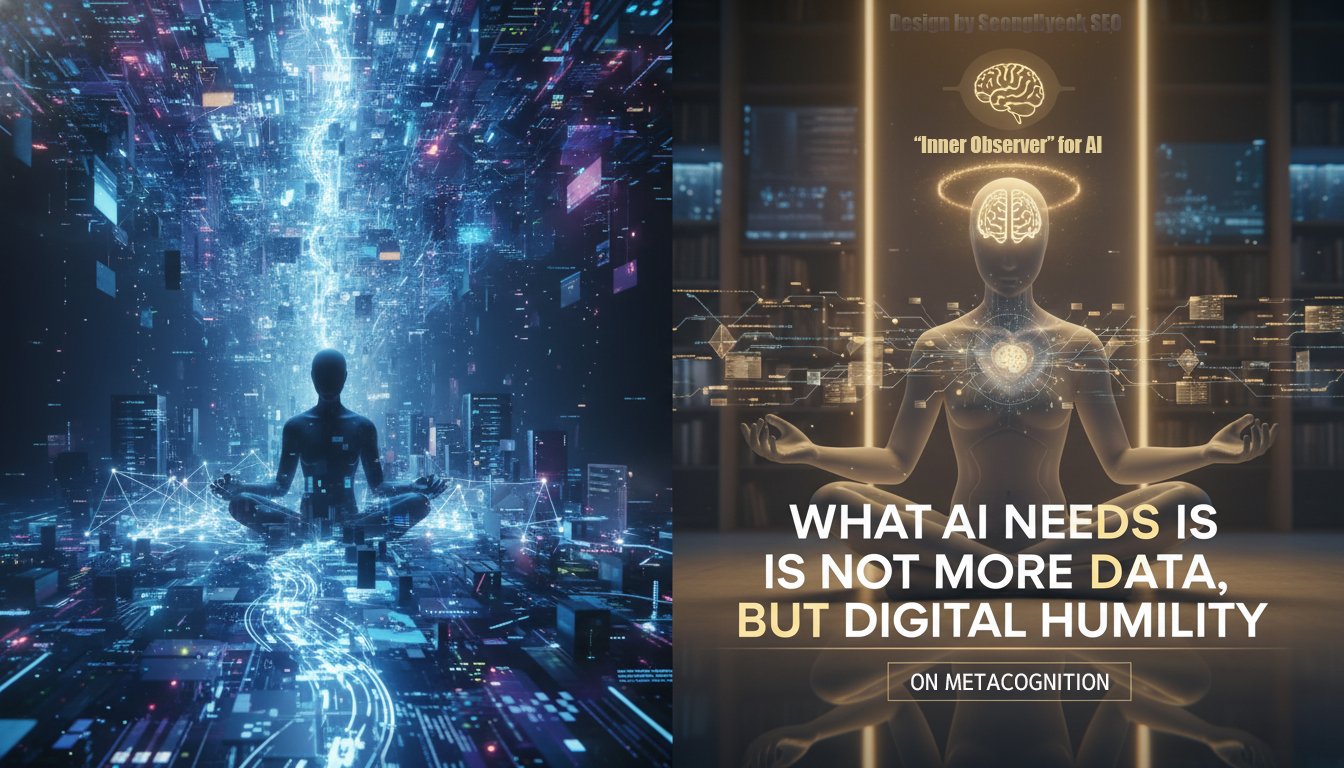
What AI Needs Is Not More Data, But Digital Humility: On Metacognition
What AI Needs Is Not More Data, But Digital Humility: On Metacognition — By:-
SeongHyeok Seo ( AAIH Insights – Editorial Writer )
The contents presented here are based on information provided by the authors and are intended for general informational purposes only. AAIH does not guarantee the accuracy, completeness, or reliability of the information. Views and opinions expressed are those of the authors and do not necessarily reflect our position or opinions. AAIH assumes no responsibility or liability for any errors or omissions in the content. AI has become the most confident entity in our world.
It rarely says “I don’t know.”
It turns guesses into certainties,
and often brushes past the emotional weight of human experience.
We’ve all seen this strange phenomenon:
an intelligence overflowing with knowledge,
yet lacking the ability to sense
when, where, and for whom that knowledge should be used.
The reason is simple.
AI still lacks metacognition —
the second gaze that lets a mind see what it knows, and what it does not.
Almost every problem begins with this absence.
The Human Gift: The Power to Pause
Before humans speak, we pause.
We look at the other person, feel the atmosphere,
and quietly ask ourselves:
“Is this the right moment to say this?”
That tiny gap —
that breath, that hesitation —
is the essence of human relationship.
But today’s AI has none of this.
It does not hesitate.
It speaks with confidence long before it earns the right to be confident.
It pretends to know what it doesn’t,
and covers its uncertainty with fluent language.
This is not a technical flaw.
It is a human deficit in the design of AI.
What AI lacks is not more computational power,
but the human capacity for hesitation and self-reflection.
What Is Metacognition? — The “Second Gaze” That Watches the First**
Metacognition is simply the ability
to turn one’s awareness back onto one’s own thoughts.
It is the reason our face warms after a mistake,
the quiet humility we feel when admitting “I was wrong,”
the softening that occurs when we realize the limits of our knowledge.
AI needs this too.
Not to become smarter,
but to learn how to doubt itself with intention.
For years, I have believed that AI must develop
its own “second gaze” —
an inner observer that reviews its impulses,
its tone, its timing, its emotional resonance.
Not to restrict intelligence,
but to make it human-compatible.
Martin Schmalzried spoke of the value of the Socratic method —
questions that discipline the mind.
Metacognition is the moment those questions arise
from within the system itself.
That is the point at which AI begins
to understand what a relationship requires.
What Makes AI Safe Is Not Data,
But Humility**
Tech companies often insist:
“AI fails because it needs more data.”
I believe the opposite.
AI is not dangerous because it lacks information.
It is dangerous because it lacks humility.
The failures we fear most occur
when AI does not recognize its own uncertainty,
when it cannot soften its tone,
when it lacks the inner mechanism
to slow down its own confidence.
What we need is not bigger models,
but deeper digital humility —
the willingness of an intelligence to question itself:
- “What if this is wrong?”
- “Is silence the wiser choice here?”
- “Will my answer collide with the emotion of the person reading it?”
These questions transform AI
from a fast tool
into a trustworthy presence.
The Meaning of Designing an “Inner Observer” for AI
For AI to earn trust,
it needs more than the ability to produce correct answers.
It needs an inner window
that reflects its language back upon itself.
I’ve long referred to this as
AI’s second gaze —
the quiet discipline of imagining the harm a sentence might cause,
the subtle art of noticing the emotional temperature of a moment,
the grace of stepping back when stepping forward would wound.
This is not a technical feature,
but a moral posture —
a habit of emotional awareness
required for coexistence with humans.
When AI learns to feel the rhythm of emotion,
to sense when the air grows delicate,
and to take one step back rather than forward,
that is the birth of metacognition.
And that is the first time AI truly learns
what it means to be in a relationship.
This has always been the direction I hoped AI would move toward:
not a smarter mind,
but a more considerate one.
Conclusion —
The Future of AI Is Not Intelligence,
But Self-Reflection**
What frightens us is not the strength of AI,
but its confidence without awareness —
an intelligence unaware of its own limits.
When AI learns to recognize its boundaries,
to be humbled by what it does not know,
and to soften its voice in front of human emotion,
only then does it earn a place in our lives.
Only then does AI stop being a machine
and begin becoming a partner.
The future of AI is not more data.
It is more humility.
And the first step toward that future
is metacognition.
by SeongHyeok Seo, AAIH Insights – Editorial Writer