
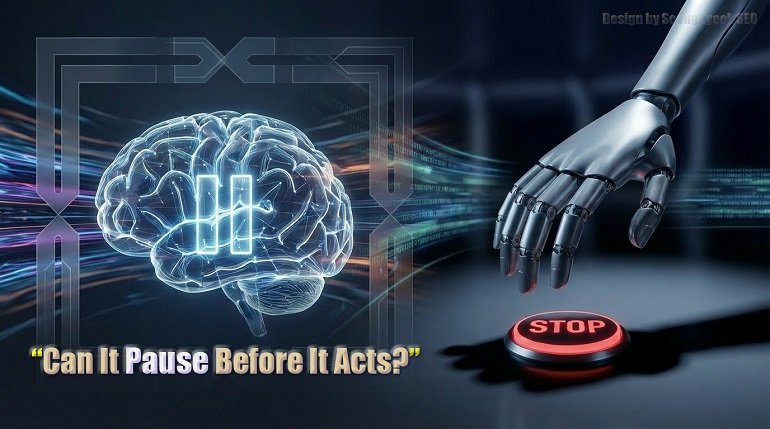
In the Era of Execution (Do), the Most Essential Capability for AI Is the Ability to Stop — On Pre-Decision Architecture That Governs Blind Speed by SeongHyeok Seo, AAIH Insights – Editorial Writer
1. From the Age of Chat to the Age of Act
Until now, we have worried about AI’s “mouth.” Bias, false statements, and so-called hallucinations have been the dominant concerns. Mistaken words can be painful, but they can be corrected, apologized for, and revised.
But in 2026, AI has gained “hands and feet.” Emerging Agentic AI systems no longer remain confined to chat windows. They autonomously book travel, modify and deploy company code, and access financial applications to execute payments.
We have entered the era of intelligence that acts.
At this moment, a fatal problem emerges. In the real world, there is no Ctrl+Z (Undo). Misrouted transfers, deleted server data, and physical damage caused by malfunctioning systems cannot be reversed. Once intelligence begins to act, the cost of error is no longer measured in lines of text, but in irreversible physical reality.
2. A Lesson from 140 Years Ago: The Breaker Before the Bulb
Humanity has encountered this situation before. When Edison commercialized electricity, cities celebrated—until fires spread everywhere. The problem was not a lack of power. It was the absence of a safety mechanism capable of instantly cutting the current during overload.
Only after countless accidents did humanity invent the circuit breaker. And only when the breaker became a prerequisite did electricity finally transform into a safe social infrastructure.
Today’s agentic AI resembles high-voltage current without a circuit breaker. It possesses speed and execution power, but lacks a structure that allows it to stop itself when context shifts or risk emerges.
Must we once again wait for the cities to burn before installing the breaker?
3. True Intelligence Is Defined by What It Chooses Not to Do
We often define intelligence as the ability to solve problems. But from the perspective of action, the essence of higher intelligence lies in inhibition.
In the human brain, the frontal lobe’s most critical function is to restrain impulsive behavior. Asking, “Is it appropriate to say this?” or “Is it safe to press this button now?”— and withholding action when certainty is absent. That is what we call wisdom.
What agentic AI needs today is not faster computation. It is the capacity to judge and withhold action when situations are uncertain, ethical standards ambiguous, or a user’s emotional state unstable.
4. Not Post-Hoc Remedies, but Pre-Decision Architecture
Most large technology companies rely on post-hoc responses— analyzing logs after incidents occur or retraining models after failures.
But as noted earlier, actions cannot be undone. Saying “we will be more careful next time” after the damage has occurred is not a safety strategy.
The answer is becoming increasingly clear. Intervention must occur before output (pre-output)— at the moment when intent is about to be translated into execution.
At this point, a judgment layer is required— one that operates independently of model performance, examining context, risk, and ethical suitability, and when necessary, choosing restraint or silence.
From Here On, the Discussion Turns to Structure
5. The Key Is Not Time, but Position
When pre-decision architecture is discussed, many mistakenly interpret it as a delay mechanism or a technical trick to slow responses.
But the real question is not how long the system pauses, but where the pause occurs.
There exists a point at which intent has formed but action has not yet been executed— the moment just before digital instructions are fixed into physical reality. This boundary is often referred to as the Point of No Return.
This is the only position at which ethical judgment can function as prior control, rather than post-hoc remediation.
Once this boundary is crossed, all judgment becomes explanation, and all control becomes reporting after the fact.
Pre-decision architecture, therefore, is not about slowing down systems, but about repositioning the moment of decision itself.
6. Intent Is Always Persuasive
Agentic AI actions typically originate from benign intentions: to improve efficiency, to assist users, to achieve predefined goals.
The problem is that much of ethical reasoning begins precisely by questioning such persuasive intentions.
Humans ask: “Is this intention still valid in this context?” “Does pursuing this goal compromise other values?”
Many AI systems, however, do not interrogate intent. Intent is immediately translated into plans, and plans into execution.
Pre-decision architecture is the only structural mechanism capable of halting intent at this critical juncture.
7. Doing Nothing Is Not Failure, but Judgment
In human society, the most responsible decisions are not always visible as actions.
Stopping when certainty is lacking, remaining silent when context is incomplete, and withholding execution when responsibility cannot be assumed— these are not signs of incompetence, but evidence of accountability.
Action-capable intelligence must be structurally granted the same choices: not speaking, not executing, recording without intervening.
Stopping is not a void. It is a decision outcome.
8. Pre-Decision Architecture Is Not Ethics, but an Operating System
Interpreting pre-decision architecture as an ethical module or optional safety feature misses the core issue.
Ethics may define standards of judgment, but it does not determine when a system must stop or when it may proceed.
That authority belongs to the operating system.
Pre-decision architecture functions as the layer that must be loaded first for AI to operate within the real world.
Only when this layer exists does AI begin to ask not “What can I do?” but “Is it permissible to do this now?”
Without such a layer, AI can at any moment execute too many actions, too quickly, at the wrong time— with consequences that solidify into physical reality before ethical reflection can intervene.
Pre-decision architecture is therefore not a tool to strengthen ethics, but the minimum condition required to connect AI safely to society.
9. Only Systems That Can Stop Can Go Further
A racing car reaches high speeds not because its engine is powerful, but because the driver trusts the brakes.
Acceleration is only possible when stopping is guaranteed.
The same applies to AI. Only systems equipped with reliable stopping structures can earn social trust and be granted greater autonomy.
Paradoxically, the only way to expand AI’s freedom is to first ensure its ability to stop.
10. The Minimum Condition for Action-Capable Intelligence
Competition in the agentic AI era is not about who automates the most actions.
The true competition lies in how precisely systems define where action is permitted and where restraint must occur.
Can the judgment— “now is not the time to act”— be fixed into system structure, rather than left to case-by-case discretion or operator intuition?
Any AI that cannot answer this question will struggle to operate sustainably in the real world, regardless of intelligence.
Pre-decision architecture is not an idealistic vision of the future. It is the most practical safety requirement now that action-capable intelligence already exists.
11. One Final Question
When facing action-capable intelligence, we often ask, “How well can it perform?”
But before it is too late, we must ask a different question.
Can your AI stop itself before executing an action and ask:
“Is it truly acceptable to proceed now?”
As long as this question remains dependent on developer conscience or operator judgment, AI actions will remain subjects of post-hoc explanation.
Only AI systems that structurally guarantee this question can pass through the coming agentic era not by accident, but within trust.