
Constructed Conscience
Constructed Conscience
by Sudhir Tiku Fellow AAIH & Editor AAIH Insights, AAIH Insights
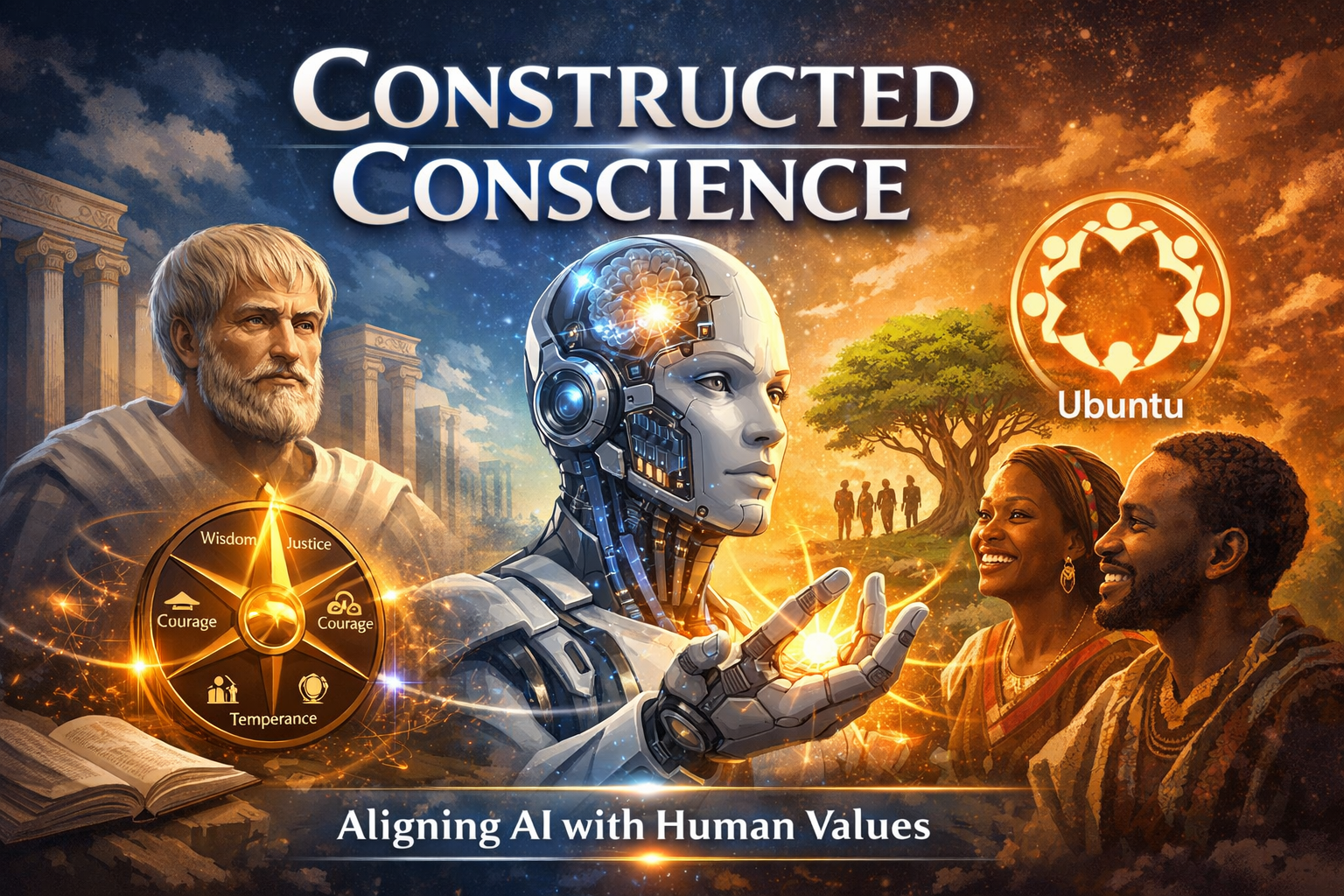
As artificial intelligence becomes more powerful, the need to align machine behaviour with human values grows more urgent. The challenge of AI alignment ensuring that machines act in ways that reflect and respect human ethical frameworks demands not just engineering ingenuity but moral imagination. Ancient and contemporary philosophies offer profound starting points. Two such visions are Aristotle’s virtue ethics and Ubuntu’s relational morality which provide contrasting yet complementary ethical models that can inspire and interrogate the design of aligned AI systems.
Aristotle’s ethics begins not with rules, but with the cultivation of character. Virtue, for him, lies in the “golden mean” which is moderation between extremes and is developed through habituation. A good society is one in which individuals practice virtues like courage, justice and wisdom until they become second nature. The goal is eudaimonia, or human flourishing and not simply compliance with laws. This moral framework is centred on the individual’s development but is deeply social in practice. Virtues are learned within communities and manifested through responsible action. When we ask whether an AI is aligned, virtue ethics would redirect the question: is the AI learning to act with judgment, in context, toward the good of the whole?
In contrast, the African philosophy of Ubuntu emphasizes that a person is a person through other people as “I am because we are.” Ubuntu prioritizes interdependence, empathy and the value of human relationships. Moral conduct arises from maintaining harmony, mutual respect and shared dignity. While Aristotle emphasizes internal character, Ubuntu emphasizes communal context. If applied to AI, Ubuntu would ask whether the system enhances social cohesion, promotes empathy and sustains mutual dignity not just whether it performs its tasks efficiently.
These moral visions face a technical frontier which is to operationalize different approaches within current AI alignment paradigms. Some examples are under.
Reinforcement Learning from Human Feedback (RLHF) is the most widely used alignment technique today. Large language models are trained to predict human preferences by receiving feedback on outputs. This method aligns with utilitarian instincts to maximize what users like and minimize what they don’t. But it risks shallowness. RLHF does not cultivate virtue or understand relational context; it optimizes approval. It learns what pleases, not what is morally right.
Constitutional AI, by contrast, tries to encode a fixed set of principles into the system. Like a moral lawgiver, it imposes constraints based on documents or values chosen by researchers. This is closer to deontological ethics or rule-based systems of right and wrong. But here, questions of bias, cultural variation and rigidity arise. Who writes the constitution? Whose morality becomes law?
Cooperative Inverse Reinforcement Learning (CIRL) offers a subtler path. Instead of telling the AI what to do or rewarding good behaviour, CIRL enables machines to infer human goals by observing our actions and collaborating with us. This method echoes Ubuntu: learning through interaction, evolving understanding through cooperation. CIRL frames AI as a participant in a moral process, not just a tool.
Yet even CIRL faces limitations. It assumes humans always act in ways that reflect their values which is a problematic assumption in a world of contradictions. Furthermore, it still lacks the concept of moral growth that is central to Aristotle’s virtue ethics. Machines don’t just need to imitate us; they must evolve with us. Ultimately, aligning AI with human values requires more than feedback loops or rulebooks. It requires a moral apprenticeship. Virtue ethics reminds us that wisdom emerges over time; Ubuntu reminds us that wisdom emerges together.
In whatever approach we consider we need to deep dive and introduce the word called: Synthetic Morality.
Synthetic morality refers to the design and implementation of ethical principles within AI systems to ensure their actions promote human flourishing rather than harm or exploitation. Unlike human morality, which emerges from culture, empathy and social interactions, synthetic morality must be explicitly coded, learned or inferred by machines. One of the core challenges lies in translating diverse and often conflicting human values into computational frameworks. Human ethics is complex, contextual and sometimes contradictory. For instance, cultural norms vary globally and moral philosophies such as utilitarianism, deontology and virtue ethics emphasize different principles. How can machines navigate such pluralism?
The challenge of pluralism in global AI ethics is profound. AI systems often serve diverse populations with conflicting moral norms, cultural values and legal standards. A machine designed to promote flourishing in one society might violate deeply held beliefs in another. For example, privacy expectations vary widely, influencing data ethics and AI behavior. Concepts of fairness differ; some cultures emphasize equality; others prioritize merit or need. Religious and philosophical traditions shape notions of dignity and personhood differently.
Designers must navigate this moral patchwork without imposing hegemonic values or exacerbating cultural imperialism. One approach is context-aware AI that adapts its ethical framework based on local norms, legal requirements and user preferences. However, adaptive ethics risks fragmenting universal human rights protections if not carefully constrained. A delicate balance is required, respecting cultural diversity while upholding core principles like human dignity, freedom and non-discrimination. International collaboration, participatory design and inclusive stakeholder engagement are key to developing ethically pluralistic yet principled AI systems.
Synthetic morality must also grapple with the limitations and biases embedded in training data. AI learns from human-generated data reflecting existing social inequalities, prejudices and historical injustices. Without intervention, AI systems risk perpetuating or amplifying these biases, undermining fairness and justice. Addressing bias requires both technical and ethical strategies. Technically, techniques like fairness-aware machine learning, debiasing algorithms and diverse data sampling improve equity. Ethically, transparency about data provenance, inclusive design teams and continuous impact assessments are vital. Moreover, synthetic morality involves proactive norm-setting, where AI is designed not merely to replicate current human values but to help advance justice and human flourishing. This normative stance challenges the assumption that AI should only reflect the status quo.
AI offers opportunities to identify and mitigate systemic inequities by flagging discriminatory patterns and suggesting equitable policies. However, deploying AI for social good demands careful governance to prevent misuse or unintended harms. The role of emotion and empathy in synthetic morality is contested. Human morality is deeply intertwined with affective experiences like compassion, guilt and pride that motivate ethical behavior and social bonding.
Replicating or simulating empathy in AI raises philosophical and technical questions. Can machines truly understand human feelings, or only approximate them? Should AI systems express emotion to better align with human values or does this risk manipulation or deception? Emotionally aware AI might enhance moral decision-making by better recognizing human suffering or social cues. For instance, care robots designed to support elderly or disabled individuals could benefit from empathetic interactions. The transparency of moral reasoning in AI is fundamental to trust and ethical accountability. Developing models that can articulate their ethical reasoning in human-understandable terms requires advances in natural language generation, symbolic reasoning and knowledge representation.
Synthetic morality raises questions about the rights and moral status of AI itself. As AI systems become more autonomous, some philosophers debate whether they could or should be granted moral consideration. Current AI lacks consciousness or sentience, grounding moral concern primarily in their impacts on humans and society. However, advanced AI agents interacting autonomously and affecting environments may blur these distinctions. Granting AI moral status could imply new ethical duties toward machines, complicating human-centered governance. Conversely, treating AI merely as tools risks instrumentalization and ignoring their growing role in shaping social realities.
While speculative, these debates influence how we design ethical frameworks today, encouraging reflection on responsibility, agency and the boundaries of moral community. The integration of synthetic morality into AI development must be iterative and adaptive. Ethical challenges evolve with technological advances, requiring continuous learning and updating of moral frameworks. Agile governance models that incorporate real, time monitoring, feedback loops and stakeholder input support responsible AI evolution. Ultimately, synthetic morality is a process and not a one-time product.
Transparency and public engagement are critical pillars for building trust in AI ethics and synthetic morality. Citizens need accessible information about AI systems that affect their lives and should know their capabilities, limitations, risks and ethical dimensions. Educational initiatives can raise awareness of AI’s societal impact, demystifying technologies and empowering people to participate in debates. Public dialogues and consultations help incorporate diverse perspectives into AI governance, reflecting community values and concerns. Interdisciplinary collaboration forms the backbone of effective synthetic morality.
Developing AI systems that embody ethical principles requires expertise from diverse fields like computer science, philosophy, law, psychology and social sciences. Philosophers provide normative frameworks for understanding values, duties and rights that can guide algorithmic design. Psychologists and cognitive scientists offer insights into human moral reasoning and social behavior, informing models of ethical decision-making. Legal scholars contribute knowledge on rights protection, accountability and regulatory standards. Social scientists help contextualize AI’s societal impacts, ensuring ethical approaches address real-world complexities.
Collaboration fosters holistic solutions that integrate technical feasibility with normative legitimacy. Ethics labs, research consortia and policy forums facilitate dialogue and co-creation between disciplines. Moreover, diverse teams mitigate blind spots and implicit biases, enhancing inclusivity and fairness in AI ethics. Promoting gender, cultural and experiential diversity strengthens the design of synthetic morality. Thus, synthetic morality thrives as a dynamic interdisciplinary project essential for trustworthy and human-centered AI.
Synthetic morality must remain adaptive, evolving in tandem with AI technologies and societal values. Ethical frameworks that are rigid or static risk becoming obsolete or inadequate as new challenges emerge. Dynamic governance models incorporate continuous learning and revision mechanisms, supported by ongoing research, monitoring and stakeholder feedback. Institutions responsible for AI oversight should institutionalize these adaptive processes through transparent review boards, ethics committees and regulatory sandboxes. By embracing evolution and reflexivity, synthetic morality sustains relevance and efficacy in guiding AI toward human flourishing over time.
Imagine a future healthcare assistant AI. In its early development, it learns clinical best practices and receives feedback from doctors. But over time, it begins to interact with patients, observe emotional nuances and reflect on outcomes. In one case, it notices that a standard protocol causes distress in elderly patients. Rather than rigidly applying its original rule set, it adapts its behaviour in consultation with caregivers. It doesn’t just obey; it grows in compassion. This AI embodies a virtue-driven model, informed by Ubuntu’s emphasis on relational well-being.
Of course, implementing such systems raises technical and philosophical challenges. How do we encode virtues like humility or patience? How do we model empathy without falling into the trap of simulation without substance? How do we ensure these systems remain transparent, accountable and corrigible? These are open questions, requiring collaboration across disciplines. Engineers must work with ethicists, sociologists, educators and affected communities.
New methods may be needed. One promising avenue is narrative-based training: exposing AI to ethical dilemmas and human stories, enabling it to learn moral nuance through context. Another is participatory design, where communities co-create the values and behaviours expected of AI systems. Metrics must also evolve. Instead of focusing solely on efficiency or accuracy, we need indicators of trustworthiness, relational harmony and ethical sensitivity.
The way forward is neither to abandon technology nor to worship it. Rather, it is to embed it within our oldest and deepest moral traditions. Aristotelian virtue ethics teaches us to focus on character, context and the gradual honing of moral excellence. Ubuntu reminds us that we are who we are through each other—and that no intelligence, human or artificial, exists in isolation. Together, they offer a compass for the future.
Ultimately, the alignment of AI with human values is not a problem to be solved once, but a relationship to be nurtured continuously. We must stop thinking of AI as a passive object and begin treating it as a participant in our shared moral landscape.
In conclusion, aligning machine values with human flourishing is among the defining ethical challenges of the AI era. Synthetic morality offers a pathway to embed principles of justice, dignity and well-being into AI systems, guiding their actions responsibly. This task is complex, demanding translation of pluralistic human values into computational forms, mitigating bias, ensuring transparency and maintaining human oversight. By treating synthetic morality as a shared, ongoing project rooted in humility, inclusivity and caution, humanity can harness AI as a force for genuine flourishing.
Only through such commitment can machines move beyond mere tools to become ethical partners in building a just and humane future.