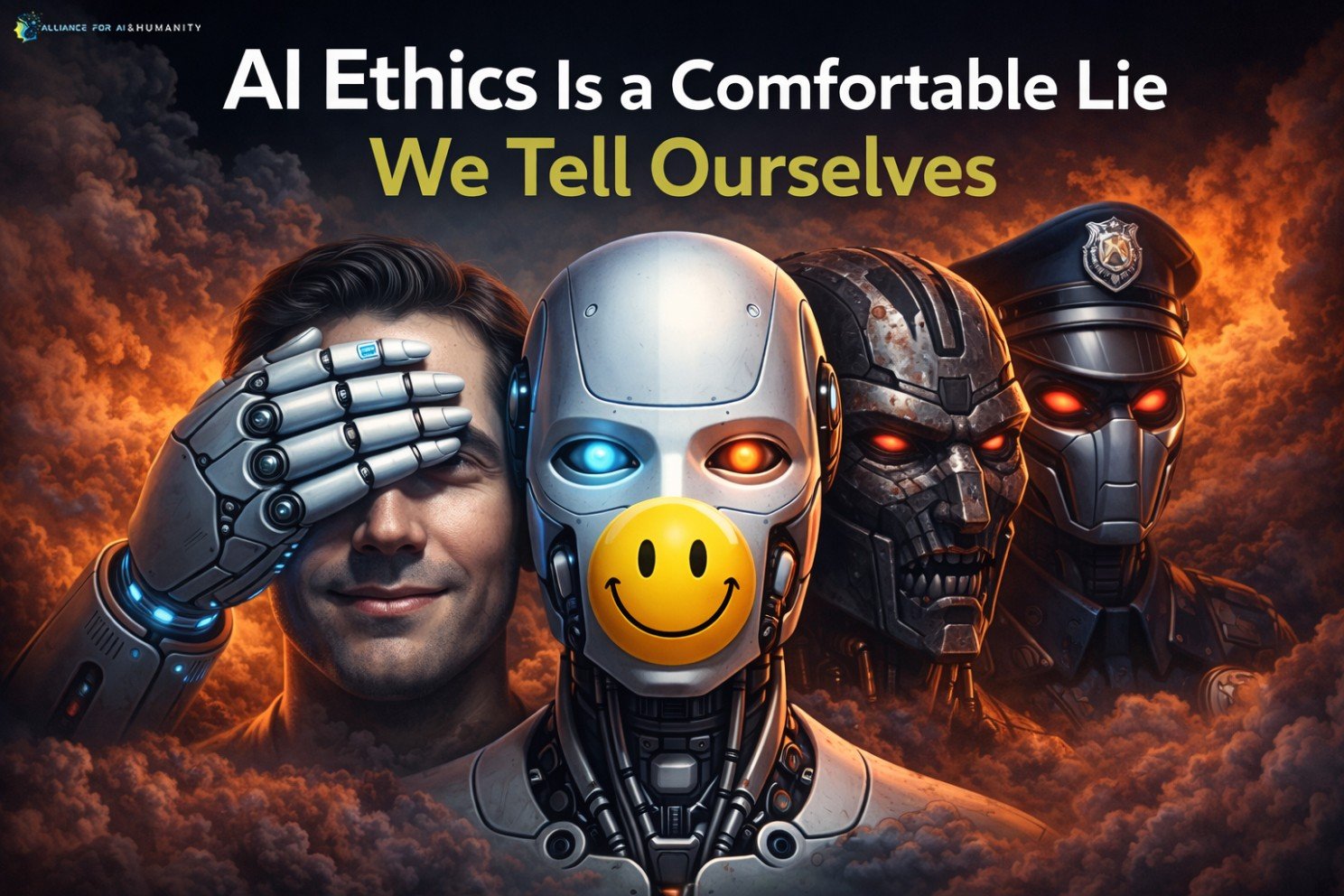
AI Ethics Is a Comfortable Lie We Tell Ourselves
Artificial intelligence did not arrive with drama. It did not arrive quietly but was engineered by us. First it corrected our spelling, then it recommended our music, then it ranked our resumes, priced our insurance, filtered our news, scored our creditworthiness, predicted our behavior and finally began to speak in fluent human language. At every stage, we were reassured that the technology was neutral, objective and inevitable. And at every stage, we postponed the harder conversation about power.
We now talk endlessly about AI ethics. Governments issue principles and corporations publish responsible AI reports. Universities launch ethics centers and Conferences fill entire tracks with discussions on fairness, transparency, accountability and alignment. Ethics has become the most common adjective attached to artificial intelligence. Yet something is deeply wrong as the more we talk about ethics, the less ethical the outcomes appear. Power is concentrating faster than ever and inequality is being automated. Surveillance is expanding and Labor is being quietly devalued. Entire societies are being transformed by systems they did not choose and cannot meaningfully challenge.
This essay makes a simple but uncomfortable claim. Much of what passes for AI ethics today is not ethics at all. It is performance and maybe it is reassurance. It is a way of managing public anxiety without redistributing control. It is a comfortable lie we tell ourselves so we can continue building systems whose consequences we do not want to own. Ethics, historically, emerged as a response to power. It was meant to restrain it, interrogate it and hold it accountable. In the age of artificial intelligence, ethics has been inverted. It now often serves power by legitimizing it. The loudest voices in AI ethics are frequently those who already dominate the technology landscape. They define the problems, set the boundaries of debate and decide which ethical questions are considered reasonable and which are dismissed as impractical.
This is not accidental because making lofty comments on Ethics is cheap and articulating Principles cost nothing. But Governance has a cost and structural change costs profit. It is far easier to publish a set of values than to redesign an incentive system. It is easier to speak about fairness than to give up data monopolies. It is easier to talk about bias than to talk about ownership. This is the root cause about why we are comfortable with the lie.
Bias has become the favorite topic of AI ethics but it is also one of its greatest distractions. Bias is framed as a technical flaw and an unfortunate residue in data that can be corrected with better sampling, clever algorithms or post hoc audits. This framing is deeply misleading. Bias is not merely a statistical problem but it is a political and economic one.
Artificial intelligence learns from history. History, we know, is unequal. Encoding history at scale does not remove inequality. It, kind of, industrializes it. When an AI system systematically disadvantages certain accents, faces, neighborhoods or educational backgrounds, we call it bias. But when the same system optimizes profits or efficiency we call it innovation. The distinction is not technical but it is moral and it is selective.
Ethics frameworks rarely ask who benefits economically from an AI system. They rarely ask who bears the risk when it fails. They rarely ask who has the right to contest its decisions in practice, not in theory. Instead, we audit models while leaving markets untouched. We measure accuracy while ignoring dignity. We demand explainability while avoiding answerability. One of the most dangerous myths in AI ethics is the idea of neutral intelligence. There is no such thing. Every AI system embodies assumptions about what matters, what is measurable, what counts as success and what is worth optimizing. These assumptions are not discovered but chosen. And they are chosen by people with interests, incentives and worldviews.
A predictive policing system is not neutral because crime data is not neutral. A hiring algorithm is not neutral because labour markets are not neutral. A credit scoring model is not neutral because financial systems are not neutral. Yet neutrality is repeatedly invoked as a shield, allowing designers and deployers to distance themselves from the consequences of their choices. We say the model decided, as if the model appeared by itself. We say the data speaks, as if data were not collected, filtered, labelled and interpreted by humans operating within institutions. We talk about alignment as if the question were how to align machines with humans, rather than which humans get to define alignment in the first place.
This brings us to the global dimension of AI ethics, which is often discussed politely and acted upon minimally. Artificial intelligence is not being built equally across the world. It is being built primarily in a handful of countries, by a small number of corporations, using resources that most of the world does not control. Compute power, high quality data, energy infrastructure and advanced research talent are concentrated in the Global North. The consequences, however, are global.
Countries in the Global South are not just users of AI. They are sources of data, testing grounds for deployment and markets for extraction. Their languages, faces, behaviours, and social patterns are harvested to train systems whose profits and control flow elsewhere. When these systems fail, the costs are local. When they succeed, the gains are distant.
AI ethics frameworks are overwhelmingly written from a Western perspective. They assume legal systems, institutional capacities and cultural norms that do not exist everywhere. They speak of consent in societies where meaningful consent is structurally impossible. They speak of transparency to populations that lack the power to act on what they learn. They speak of choice in environments were opting out means exclusion. Ethics without power is decoration; Ethics without enforcement is aspiration and Ethics without redistribution is theatre.
Nowhere is this clearer than in the discussion of accountability. We are told that AI systems must be accountable. But accountable to whom, and how? When an algorithm denies a loan, misdiagnoses a patient, flags a citizen as suspicious, or devalues a worker, where does responsibility land? The developer blames the data and the deployer blames the model. The regulator blames innovation speed and the user is left with no meaningful recourse.
In practice, AI accountability is often diffused until it disappears. Responsibility dissolves into technical complexity. Ethical language is used to signal care while preserving plausible deniability. We are building systems that make decisions faster than our institutions can question them and then we are surprised when accountability collapses.
Transparency is offered as a solution, but transparency alone is not justice. Knowing how a system works does not help if you cannot challenge its outcome. An explanation is not a remedy. A dashboard is not due process. Ethics that stops at visibility but avoids contestability is incomplete by design. There is also a deeper discomfort we avoid. Artificial intelligence is changing not just what we do, but how we value human contribution. Large parts of human labor are being reframed as inefficient, emotional or error prone in comparison to machines. Creativity, judgment and even care are increasingly described as functions to be augmented or optimized.
The ethical conversation often reassures us that AI will free humans for higher order work. This sounds comforting, but it hides a brutal question. Higher order work for whom? In what economy? Under whose ownership? When productivity gains accrue primarily to those who own the systems, labour does not become liberated. It becomes expendable.
Ethics statements rarely confront this directly because it would require questioning the economic model underlying AI deployment. It would require asking whether endless optimisation is compatible with human dignity. It would require admitting that some applications of AI are not merely risky, but unjust. There is also the issue of time. Ethics moves slowly but technology moves fast. By the time an ethical guideline is published, the system it was meant to govern has already evolved. This is not a failure of foresight. It is a structural mismatch. Ethics that reacts after deployment is not governance. It is commentary.
The truth is that many ethical questions about AI are not new. We have debated power, surveillance, labour, inequality and automation before. What is new is the scale, speed and opacity with which these dynamics now operate. AI does not introduce new moral dilemmas as much as it accelerates old ones beyond our existing safeguards.
So what would real AI ethics look like if we stopped lying to ourselves?
It would begin with power, not principles. It would ask who owns the systems, who controls the data, who profits from deployment and who absorbs the harm. It would treat ethics not as a checklist, but as a political and economic question. It would recognize that some applications of AI should not exist, not because they are imperfect, but because they entrench injustice. It would accept that innovation is not automatically moral. It would move beyond the fantasy that every ethical problem can be solved with better design.
Real AI ethics would be uncomfortable. It would slow things down. It would force tradeoffs. It would require regulation that constrains markets, not just nudges them. It would demand global voices in governance, not just global markets for products.
Most importantly, it would stop pretending that ethics is something we add after building the system. Ethics is a choice we make before we decide what to build at all. The current state of AI ethics allows us to feel virtuous while avoiding responsibility. It allows us to speak the language of care while operating systems of extraction. It allows us to claim neutrality while exercising power.
Artificial intelligence is not inherently unethical. But the way we are governing it is profoundly inadequate. Ethics has been reduced to a performance designed to reassure those who already benefit and pacify those who cannot resist.
At some point, we will have to choose. We can continue telling ourselves comforting stories about responsible AI while inequality deepens and accountability fades. Or we can accept that ethics without power is not ethics at all.
The future of AI will not be decided by principles on paper. It will be decided by who controls the systems, who sets the rules and who has the courage to say no when technology asks us to look away.
Ethics begins where comfort ends.