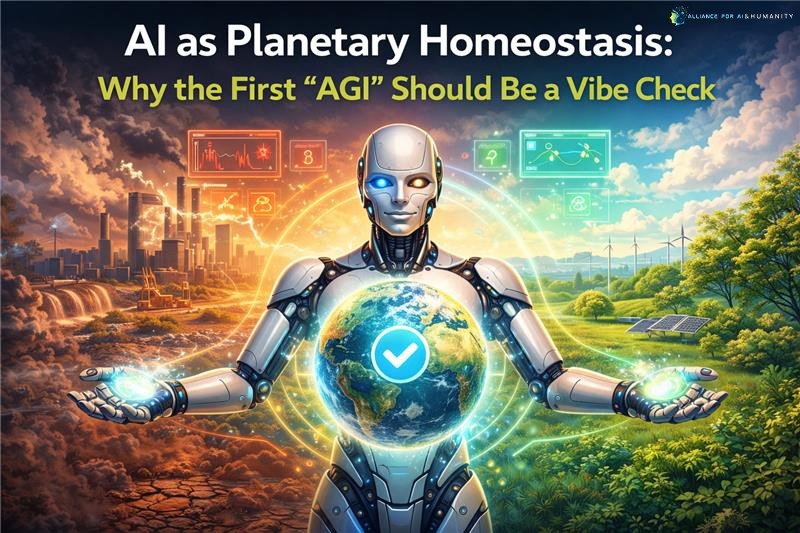
AI as Planetary Homeostasis: Why the First “AGI” Should Be a Vibe Check
When people hear “AGI,” they often imagine something like a mind. A system that thinks, understands, and perhaps even becomes conscious. They picture a digital person, a new kind of subject, maybe even a rival. The debate quickly becomes metaphysical. Is it alive. Does it have intentions. Does it deserve rights. Can it become evil.
But there is another way to frame the next step in AI, one that is less dramatic and more urgent.
Before we chase conscious AGI, we should build AI as a homeostatic layer for Earth.
Homeostasis is a simple idea. A living system stays alive because it can keep certain variables within a viable range. Temperature. Blood sugar. Hydration. Oxygen. Salt. When those drift too far, the system compensates. It sweats. It shivers. It gets thirsty. It changes behavior. It corrects.
Homeostasis is not intelligence in the heroic sense. It is not a genius. It is not a philosopher. It is a governor, a regulator, a continuous feedback loop that notices when the system is drifting, and nudges it back toward stability.
Now scale that idea up.
Earth is not a single organism, but it behaves like a coupled system of systems. Oceans, forests, soils, ice sheets, weather patterns, supply chains, cities, markets, institutions, cultures. Some of these are biophysical. Some are social. Some are technical. They interact, sometimes smoothly, sometimes violently. When the interactions destabilize, crises appear. Drought. Flood. Fire. Food shocks. Migration pressure. Political polarization. Wars. Not every crisis has the same cause, and not every crisis is climate. But again and again, we see a pattern of feedback loops amplifying each other.
This is where a different vision of “AGI” becomes interesting.
What if the first truly meaningful “general intelligence” we build is not a conscious mind, but an Earth-scale homeostatic system. A system whose job is not to write essays or imitate human conversation, but to perform a continuous “vibe check” on the planet. A system that monitors biosphere health, thermodynamic constraints, resource flows, and social instability signals, and that helps humans coordinate responses before thresholds are crossed.
A vibe check sounds trivial, but it is exactly what healthy organisms do.
An organism does not wait until it collapses to realize something is wrong. It detects early signals. It detects trends. It detects thresholds. It detects when small disturbances are becoming a drift, and when drift is becoming danger.
Our societies are often terrible at that.
We are very good at reacting to headlines. We are very bad at reacting to slow variables. We respond after the hospital fills up, not when the early infection curves begin. We respond after the river dries, not when the groundwater slowly declines. We respond after trust collapses, not when discourse becomes brittle and cynical. We respond after the supply chain breaks, not when a few key nodes start to overload.
We also struggle because information is fragmented. Scientific measurements sit in one place. Economic indicators sit in another. Social data is private and siloed. Local knowledge is ignored. Political incentives reward short-term wins. And even when we do have data, we rarely have an integrated picture that feels real enough to change behavior.
This is where AI could be used differently.
Not as a replacement for human judgment, but as a planetary instrument panel.
Imagine an AI system that is trained and designed to do three things well.
First, it can integrate many kinds of signals without pretending they are all the same. Satellite data, sensor networks, ecological indicators, public health metrics, energy flows, logistics, food prices, water stress, biodiversity proxies. Not to predict the future with certainty, but to show where stresses are accumulating.
Second, it can represent uncertainty honestly. Homeostatic systems do not need perfect knowledge. They need actionable thresholds and robust warnings. They need to say: we are entering a risk zone, here are the variables that matter, here are plausible trajectories, here is what would reduce risk, here is what would increase it.
Third, it can detect social “noetic” instability. This may be the most controversial part, but it should not be ignored. Societies also have vital ranges. Trust. Cohesion. Shared reality. The ability to disagree without collapsing into hostility. When those drift, governance fails. Coordination fails. Even good science becomes useless because collective action becomes impossible. Ideological polarization, information disorder, and extreme distrust can be treated not only as political topics, but as early warning signals of a system losing its capacity to self-regulate.
This does not mean policing opinions. It means recognizing that when a society’s cognitive ecology becomes unstable, every other crisis becomes harder to handle.
In that sense, the first “AGI” we should build is not a digital person. It is a capacity for planetary situational awareness.
And if that sounds too modest, consider the alternative.
We are currently building AI mainly as a productivity engine and a persuasion engine. We are scaling systems that can generate text, images, and decisions at speed, inside markets that reward engagement and profit. That direction can create enormous value. But it can also amplify instability. It can accelerate consumption. It can accelerate misinformation. It can accelerate strategic deception. It can accelerate the very polarization that undermines coordination.
If we build only that kind of AI, we may end up with systems that are brilliant at local optimization and terrible at planetary stability.
Homeostatic AI is the opposite. Its purpose is to make the whole system more survivable.
But here is the crucial point. If AI becomes planetary-risk infrastructure, then the main problem is no longer engineering. It is governance.
Because a planetary “vibe check” system raises questions that go to the heart of legitimacy.
Who decides what counts as a risk. Who decides what is measured. Who owns the data. Who has access to the warnings. Who can act on them. Who can ignore them. Who can manipulate them. Who can override the system when it becomes inconvenient.
And what about privacy.
A homeostatic layer that monitors social instability could easily become a surveillance layer. A system meant to prevent crises could become a system used to pre-empt dissent. A tool designed to support coordination could become a tool that imposes a single worldview. A dashboard built for the common good could be captured by states, corporations, or security agencies.
So the question is not only whether such a system is possible. The question is whether it can be legitimate.
If we take the “planetary homeostasis” idea seriously, then responsible AI requires at least four kinds of care.
It requires ethical care. The system should be designed to support human flourishing, not to normalize coercion. It should not silently embed a narrow set of values and export them at planetary scale.
It requires privacy care. The system should minimize the collection of personal data. It should use aggregation and protection by design, not as an afterthought. It should avoid turning social monitoring into individual profiling.
It requires political care. The system must not become a technocratic oracle that replaces democratic contestation. It should inform decisions, not dictate them. It should make trade-offs visible, not hide them behind “the model says so.”
It requires institutional care. There must be oversight that is not merely internal. There must be checks that prevent capture. There must be clear accountability when the system fails, and clear responsibility for how it is used.
In other words, if AI becomes a new nervous system for civilization, it cannot be owned like a consumer app.
It has to be governed more like public infrastructure. In this sense, an AI as homeostat should be built within the open source ethos and spirit, and sit at the heart of the Internet, with no single organisation, nation state or private company in “control”.
This is not a call to build a single centralized world brain. In fact, that would be dangerous. Homeostasis is more robust when it is distributed. When many subsystems sense, interpret, and respond, and when no single node becomes the point of total control. A planetary vibe check should be plural, transparent, and contestable. It should support many perspectives, not collapse them into one. In this regard, blockchain technology could help, by creating a distributed network of AGIs who reach consensus in a decentralized way about homeostatic parameters and courses of action.
The loudest conversations about AGI focus on whether AI will become conscious. But even if it never does, it can still function as a planetary organ. It can still shape what humans perceive as urgent. It can still shape what institutions treat as real. It can still shape which risks are acted upon and which risks are ignored.
So perhaps the first test of “AGI” is not a Turing test. It is not a benchmark. It is not a debate about inner experience.
It is whether we can build a system that helps maintain a kind of planetary stability in a world of accelerating feedback loops, without turning that system into a tool of domination.
That is what a real vibe check would measure.
Not the intelligence of the machine, but the maturity of the society building it.