
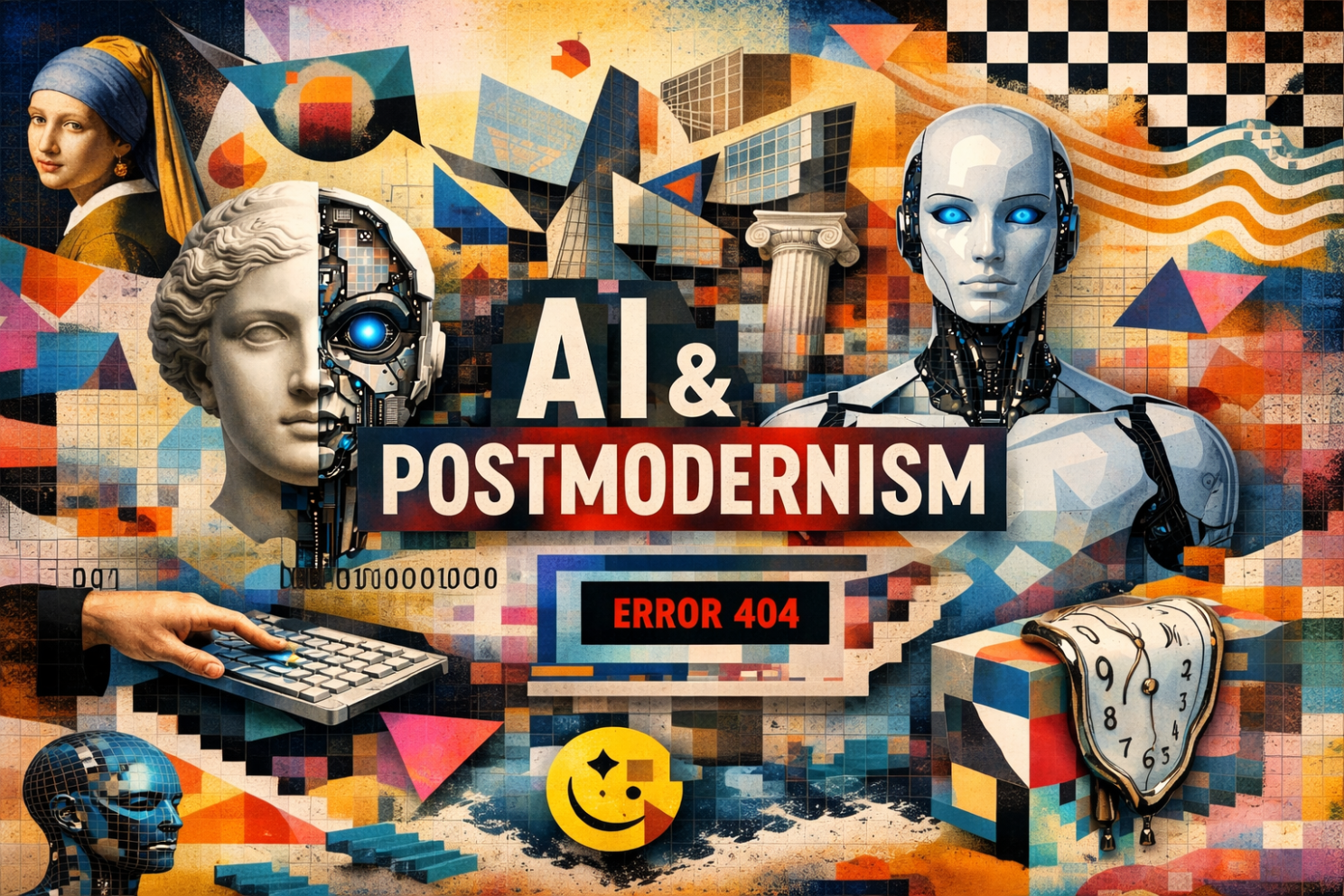
AI and Postmodernism by Sudhir Tiku Fellow AAIH & Editor AAIH Insights, AAIH Insights
Postmodernism emerged as a deep suspicion toward grand narratives that claimed universal truth, moral certainty and historical inevitability. Thinkers such as Jean-François Lyotard argued that modern societies legitimated knowledge through sweeping stories about progress, reason, or emancipation and that these stories masked structures of power beneath their promise of objectivity. Artificial intelligence now enters this philosophical terrain not merely as a technical innovation but as a new site where knowledge is produced, validated and distributed at scale. The ethical question is therefore not limited to whether AI systems are biased or inaccurate, but whether they quietly reinstate a new grand narrative under the banner of data driven neutrality.
Large scale AI systems are trained on enormous datasets that aggregate fragments of human expression across languages, cultures and histories. The resulting models generate responses that appear comprehensive and balanced, yet the appearance of balance often conceals the dominance of certain linguistic and cultural patterns. A postmodern lens reminds us that no dataset is innocent and no aggregation is neutral because inclusion and exclusion are always political decisions shaped by economic and institutional power. When AI systems speak in a tone that feels universal, they may in fact be reproducing the epistemic priorities of those who control computational infrastructure and data pipelines. AI ethics informed by postmodernism therefore begins with incredulity toward algorithmic authority and treats model outputs as situated narratives rather than final verdicts.
The philosopher Michel Foucault argued that knowledge and power are intertwined in such a way that regimes of truth emerge through institutional practices rather than through pure rational discovery. Artificial intelligence embodies this insight in a technical form because the training process operationalizes certain patterns as statistically legitimate while marginalizing others as noise. What becomes predictive becomes authoritative, and what becomes authoritative gradually shapes institutional decisions in hiring, credit allocation, policing, and education. The ethical challenge is not only to remove bias but to interrogate the conditions under which particular forms of knowledge become encoded as algorithmic norms. When AI systems rank candidates or summarize political debates, they do not simply mirror reality but participate in constructing the categories through which reality is interpreted.
Postmodern theory also destabilized the idea that meaning is fixed and transparent. The work of Jacques Derrida emphasized that texts contain internal tensions and that interpretation depends on context, perspective, and difference. AI models operate by compressing linguistic variability into probabilistic structures that predict the most likely continuation of a sentence or argument. This process can produce remarkable fluency, yet it also risks smoothing over ambiguity and reducing the space for interpretive plurality. When millions of users rely on generative systems to draft essays, speeches and policy proposals, language itself may converge toward optimized patterns that privilege clarity and consensus over productive disagreement. An ethics shaped by postmodern sensitivity would resist this convergence and preserve room for heterogeneity, irony and dissent.
Another postmodern insight concerns the fragmentation of identity and the recognition that the self is not a stable essence but a dynamic construction shaped by social discourse. AI systems increasingly participate in the formation of identity by curating content, suggesting responses and recommending cultural artifacts. Recommendation engines influence aesthetic preferences, while language models influence how individuals articulate their thoughts in professional and personal contexts. The ethical issue is not simply that AI might manipulate users, but that it may normalize particular identity templates through subtle nudges that reward conformity to statistically dominant styles. Postmodern ethics calls for vigilance against normalization disguised as personalization and demands that individuals retain interpretive agency rather than becoming passive recipients of algorithmically filtered meaning.
Postmodernism also challenges the distinction between fact and narrative by highlighting the ways in which supposedly objective descriptions are embedded in cultural frames. AI intensifies this tension because predictive outputs often carry prescriptive implications. When a model identifies a neighborhood as high risk or a candidate as low suitability, the descriptive claim can quickly transform into a normative judgment that influences real world outcomes. The compression of what is statistically likely into what ought to be done exemplifies the ethical danger of conflating probability with value. A postmodern informed AI ethics would reintroduce a critical distance between prediction and prescription and ensure that algorithmic outputs remain advisory rather than determinative.
Finally, postmodernism encourages skepticism toward totalizing systems that claim comprehensive explanatory power. AI systems that integrate text, images, code and behavioral data may appear to approximate such totality, especially when marketed as general intelligence. Ethical reflection must resist the temptation to treat these systems as neutral arbiters of truth and instead recognize them as contingent constructions shaped by training data, optimization goals, and institutional incentives. In this sense, postmodernism does not reject technology but equips society with conceptual tools to question its authority and to prevent the reemergence of unexamined grand narratives in digital form.
Pluralism, Power and Ethical Design in an Algorithmic Age
If postmodernism invites skepticism toward universal narratives, it also opens space for pluralism and contextual ethics. Artificial intelligence systems operate across diverse cultural environments, yet many alignment frameworks implicitly assume a relatively homogeneous moral landscape rooted in liberal individualism. Postmodern thought reminds us that values are historically situated and socially negotiated rather than universally self-evident. An AI ethics attentive to pluralism must therefore acknowledge that concepts such as fairness, privacy, and autonomy carry different meanings across societies. The task is not to abandon shared principles but to design systems that accommodate contextual variation while preserving fundamental safeguards against harm.
Value pluralism becomes especially salient when AI systems are deployed globally in education, healthcare, and governance. A language model trained predominantly on English language data may reproduce assumptions about social roles and norms that do not align with local traditions elsewhere. Ethical design in this context requires participatory processes that involve diverse stakeholders in shaping model behavior and evaluation metrics. Postmodernism supports such participatory governance because it resists the imposition of a single authoritative perspective and instead favors dialogical engagement among multiple voices. In practice this may involve localized fine tuning, community oversight boards, and culturally sensitive auditing protocols that treat ethics as an ongoing negotiation rather than a static checklist.
Power asymmetry remains central to this discussion because the infrastructure necessary to train advanced models is concentrated in a small number of corporations and states. Control over compute resources, proprietary datasets, and cloud platforms translates into influence over which epistemic frameworks become globally dominant. Postmodern analysis of power can illuminate how these concentrations shape not only economic outcomes but also symbolic authority. When AI systems become embedded in search engines, productivity software, and public services, they mediate access to knowledge and opportunity. Ethical responses must therefore address structural inequalities by promoting transparency in data sourcing, equitable access to computational resources, and regulatory frameworks that prevent monopolistic consolidation of algorithmic influence.
Postmodernism also foregrounds the instability of meaning and the importance of interpretation. In the context of AI, this insight suggests that explainability should not be reduced to technical transparency alone. Providing access to model weights or architectural diagrams does little to empower ordinary users if they lack the expertise to interpret them. Ethical explainability requires communicative clarity that translates complex processes into narratives accessible to affected communities. Such translation acknowledges that meaning arises in dialogue and that trust depends on mutual understanding rather than on the mere disclosure of technical details.
Another crucial dimension involves cognitive sovereignty and the preservation of human agency in environments saturated with algorithmic mediation. AI systems that optimize engagement and predict preferences can gradually shape attention patterns and belief formation. Postmodern thought highlights how discourse structures perception and identity, which implies that algorithmic curation is never neutral. Ethical design must therefore incorporate mechanisms that allow users to adjust recommendation parameters, access alternative perspectives, and understand how their data informs content selection. Protecting cognitive sovereignty means ensuring that individuals remain capable of critical reflection rather than being subtly steered toward preconfigured informational pathways.
Environmental considerations further complicate the ethical landscape because the computational demands of large-scale AI systems carry material consequences. Data centers consume significant energy and water resources, and hardware supply chains involve extraction of rare minerals with social and ecological implications. A postmodern sensibility that questions narratives of technological inevitability can help resist complacency about these externalities. Instead of assuming that ever larger models represent linear progress, ethical discourse can interrogate the tradeoffs between performance gains and environmental costs. Sustainable AI development requires integrating ecological metrics into evaluation frameworks and incentivizing efficiency alongside capability.
Ultimately, integrating postmodern insights into AI ethics does not entail relativism or cynicism but rather a disciplined attentiveness to context, power, and plurality. Artificial intelligence systems are not autonomous moral agents but socio technical constructs embedded in networks of institutions, incentives, and cultural narratives. Recognizing this embeddedness prevents the reification of AI as an independent authority and reinforces the responsibility of designers, policymakers, and users to shape its trajectory.
The future of AI ethics will likely depend on balancing skepticism with constructive design. Postmodernism teaches that no system is beyond critique and that claims to universality warrant careful examination. At the same time, societies must develop shared frameworks that enable coordination and accountability in a world where algorithmic systems influence everyday life. The challenge lies in crafting governance structures that are flexible enough to accommodate diversity yet robust enough to prevent harm. By embracing incredulity toward meta narratives while committing to participatory and context sensitive design, AI ethics can evolve into a mature discipline capable of guiding technological development without surrendering to either naive optimism or paralyzing doubt.