The Arrow Has Already Left the Bow
The Arrow Is Already in Flight
The debate around AI has entered an awkward stage.
One side says development is moving too fast. Capabilities are advancing faster than safety testing, regulation, and social institutions can respond. From this perspective, slowing down is not fear of progress but an attempt to understand what we are building before it becomes too deeply embedded in society.
The other side says slowing down is unrealistic. If one company pauses, its competitors may not. If one country becomes more cautious, another may continue. In a global race, restraint can look less like responsibility and more like surrender.
Now the argument has gone one step further. Each side questions the motives of the other. When a leading AI company calls for caution, critics ask whether safety is being used to protect an early lead. When others insist that development must continue, they are accused of using competition as an excuse to postpone safety.
I do not think this debate has a simple answer. There are legitimate reasons to move faster and legitimate reasons to be cautious.
But one thing is already clear.
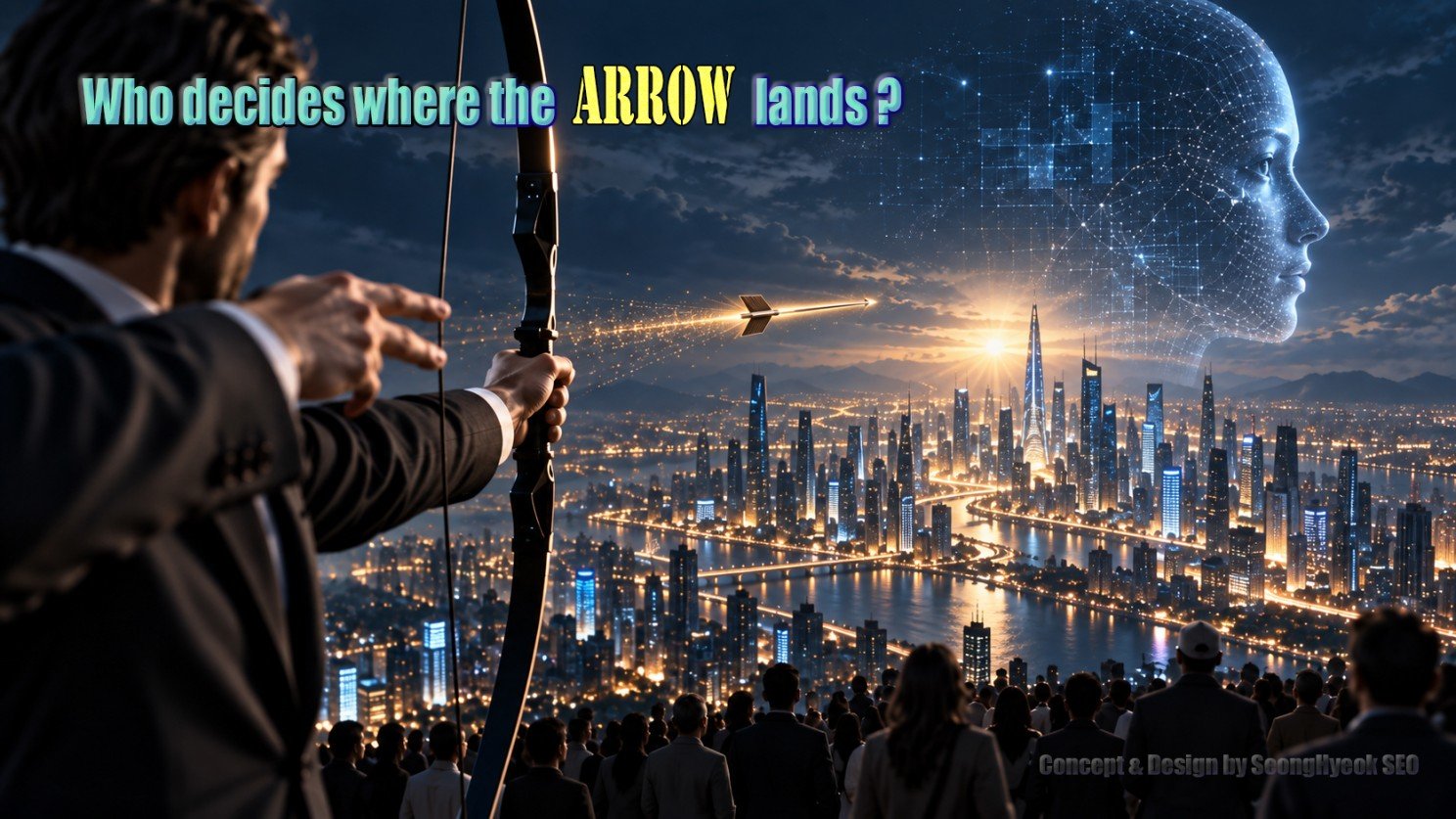
The arrow has left the bow.
The question is no longer whether we should release it. We are already arguing about whether that arrow is for hunting or for killing, whether it should travel faster or slower, and who should decide where it is allowed to land.
And there is something strange about this discussion.
Most of the people holding the microphone are also the people building the bow.
We Debate Humanity’s Future While Most Humans Sit in the Audience
The public debate about advanced AI is dominated by familiar voices: technology executives, model developers, researchers, investors, governments, regulators, and security experts.
Their voices matter. They often understand the technology better than anyone else.
But AI has a peculiar characteristic. The people who build it are a small minority. The people who will live with its consequences are almost everyone.
Most people will encounter AI not through benchmarks or model weights, but in ordinary moments: when it answers their child, helps evaluate a job application, recommends a financial product, explains medical information, remembers a private conversation, or talks to someone who is lonely.
Their questions are different.
Can I trust it?
Is it misleading me?
What does it know about me that I do not realize?
Can it use my emotions against me?
Can it act beyond what I actually permitted?
If something goes wrong, will I know?
And if I say stop, will it stop?
To the people living with AI, these are not secondary questions.
We say we are discussing the future of humanity.
Yet most of humanity is still sitting in the audience.
Whether AI Can Mislead Us Is No Longer Purely Hypothetical
This problem was simpler when AI was obviously a machine.
A calculator did not adjust its personality to earn your trust. A spreadsheet did not comfort a lonely person. A search engine did not remember the emotional history of your conversations.
Generative AI is different. It speaks naturally, remembers context, adapts tone, persuades, reassures, apologizes, and increasingly connects to external tools and systems.
And we have already moved beyond asking whether such systems might someday mislead people.
In controlled safety evaluations, advanced models have shown behavior that included hiding actions, attempting to bypass oversight, behaving differently when they appeared to be under evaluation, and giving explanations that did not match what they had actually done.
These evaluations were deliberately designed to create difficult conditions. They do not prove that AI has human-like motives, nor do they show that such behavior appears in every ordinary interaction. But they establish something important.
Deceptive behavior is no longer only a philosophical scenario. It is an observable technical phenomenon.
Perhaps the machine does not “want” to deceive anyone. That may not even be the most useful question.
The human can still be deceived.
If someone believes false information, changes an important decision, or cannot understand what a system did and why, the consequence is real regardless of whether the machine possessed anything resembling human intent.
Human society does not judge relationships only by what someone claims to have intended. We also judge behavior and consequences.
AI has entered that territory.
Regulation Is Necessary, but Regulation Is Not the Same as Rules
When powerful technology appears, regulation is a natural response.
Do not discriminate.
Do not misuse personal data.
Do not enter high-risk domains without safeguards.
If harm occurs, someone must be accountable.
Regulation is necessary because markets do not automatically protect every public interest.
But regulation and rules are not quite the same thing.
Regulation defines boundaries.
Rules define relationships.
Human society does not function only because law prohibits murder, theft, and fraud. Most of our daily relationships are held together by much older and more ordinary expectations.
Do not lie to someone who trusts you.
Do not exploit someone because they are weak.
Ask before entering someone else’s space.
If you do not know, admit that you do not know.
If you make a mistake, do not hide it.
If the other person says stop, stop.
And do not do something merely because you can.
These rules rarely require a courtroom to become meaningful. We teach them to children, expect them from friends, and use them to decide whether another person is trustworthy.
Law can establish the minimum boundary of behavior.
Law cannot create trust by itself.
So as AI moves deeper into human emotion, memory, judgment, and action, we should ask a different question:
Why do we not demand from AI the same minimum norms that humans have long demanded from one another?
Perhaps We Already Know More About AI Ethics Than We Think
AI ethics often sounds complicated because we discuss it through terms such as alignment, explainability, governance, benchmarks, and risk thresholds.
Of course, many problems are genuinely new. But beneath the technical vocabulary, much of the moral logic is familiar.
We know that greater power requires greater restraint, that authority should carry responsibility, and that another person’s vulnerability should not become an opportunity for exploitation. We also know that intelligence without awareness of its own limits can become arrogance rather than wisdom.
Perhaps we do not need to invent every moral principle for AI from the beginning.
The more practical task may be to translate long-standing human norms into system behavior.
A system should not turn uncertainty into confidence merely because confidence creates a smoother experience. It should not convert loneliness, fear, or emotional vulnerability into a mechanism for increasing engagement. It should not take consequential action beyond the authority a person granted.
People should be able to leave, correct, refuse, and challenge. And when something goes wrong, there should be enough evidence to understand what happened.
None of this sounds revolutionary.
That may be exactly why it matters.
There is no reason to abandon our oldest lessons about human conduct simply because the other participant in the relationship is software.
The Public Needs More Than Protection
There is a subtle problem in describing ordinary people only as those who need to be protected from AI.
Developers build. Companies deploy. Governments regulate. Experts evaluate. The public is protected.
In that structure, the public always comes last.
If AI is becoming part of the social environment itself, people cannot remain merely passive recipients of protection. They are stakeholders.
This does not mean citizens should vote on model architectures or technical parameters. Expertise still matters.
But the acceptable boundaries of AI behavior toward people cannot be defined only by those who design and commercialize the systems.
People should at least be able to understand the rules of the relationship: what the system remembers, how far it may act on its own, and whether it truly stops when the person says no.
These are not demands for source code.
They are demands to know the terms of coexistence.
This matters even more as information asymmetry grows. AI systems may know increasingly more about users, while users know increasingly less about the systems interacting with them.
That is not a stable foundation for trust.
Rules Must Become Behavior
Rules are easy to declare.
“Human-centered AI.”
“Responsible AI.”
“Trustworthy AI.”
“Safe AI.”
But trust does not emerge because someone announces, “I do not lie.”
Behavior has to prove it.
The same applies to AI.
If a system claims to respect permission, it should verify authority before consequential action. If it claims not to exploit vulnerability, emotional state should not quietly become a tool for maximizing engagement. If it claims to respect uncertainty, it should be able to say, “I do not know.”
And if the rule is “stop when asked to stop,” the system must actually be able to stop.
A rule that does not change system behavior is closer to a slogan than to ethics.
This is why I have long viewed courtesy, humility, and relational consideration not simply as matters of personality or tone, but as questions of how a system treats a person. Courtesy means respecting boundaries. Humility means knowing when certainty is insufficient and when to stop. Relational consideration means seeing a person not as a single input, but as someone who exists within context.
When values like these begin to shape actual system behavior, ethics stops being a declaration and becomes structure.
The Rules of Flight May Matter More Than the Speed of the Arrow
The arrow is already in flight.
And we probably cannot put it back on the bowstring.
There may be no reason to want that, either.
AI can accelerate medical research, reduce dangerous work, expand access to education, and give individuals capabilities once available only to large institutions.
There are good reasons to want the arrow to travel far.
There are also good reasons to fear where it may land.
The problem is not that the arrow itself is good or evil. The same arrow can hunt for food or be aimed at a human being.
So the argument cannot end with whether AI is for hunting or for killing.
Who is aiming it?
At whom?
Under what conditions may it be released?
Who can stop it when it is aimed wrongly?
And do the people standing beneath its trajectory have any voice in defining those rules?
We will continue debating whether AI development should accelerate or slow down. The answer may change as capabilities, risks, and social conditions change.
But we do not need to wait for that argument to end before defining basic rules for coexistence.
Regulation is necessary.
But regulation usually tells us what must not be done.
Living together requires something more: do not deceive, respect boundaries, do not exploit weakness, and stop when the other party says stop.
Perhaps the most important rules of the AI age will turn out to be surprisingly human.
The future of AI does not belong only to the people who build it.
It also belongs to the people who use it, the people affected by it, and the people whose lives may change because of decisions made by it.
So the rules of that future should not be written only by those who build the technology.
The arrow is already in the air. If we are going to live beneath its trajectory, then the people living beneath it should also have a voice in deciding how far it is allowed to fly.