Why Are We Only Now Asking What Must Remain Human?
Why Are We Only Now Asking What Must Remain Human?
SEONGHYEOK SEO
Bill Gates recently published a long essay about artificial intelligence.
Among the many questions he raised, one phrase stood out:
“Human Reserved.”
The idea is intuitive. Even if AI and robots become capable of doing certain things, society may decide that some of them should remain in human hands.
Gates compares the idea to a nature reserve: a place we could develop, but deliberately choose not to because something valuable would be lost.
Many people will read that and say:
“Of course.”
Of course there should be moments when a doctor, not a machine, speaks to a patient.
Of course care cannot always be reduced to efficiency.
Of course some decisions involving dignity, grief, responsibility, or human relationships should not automatically be handed to an algorithm.
My reaction was different.
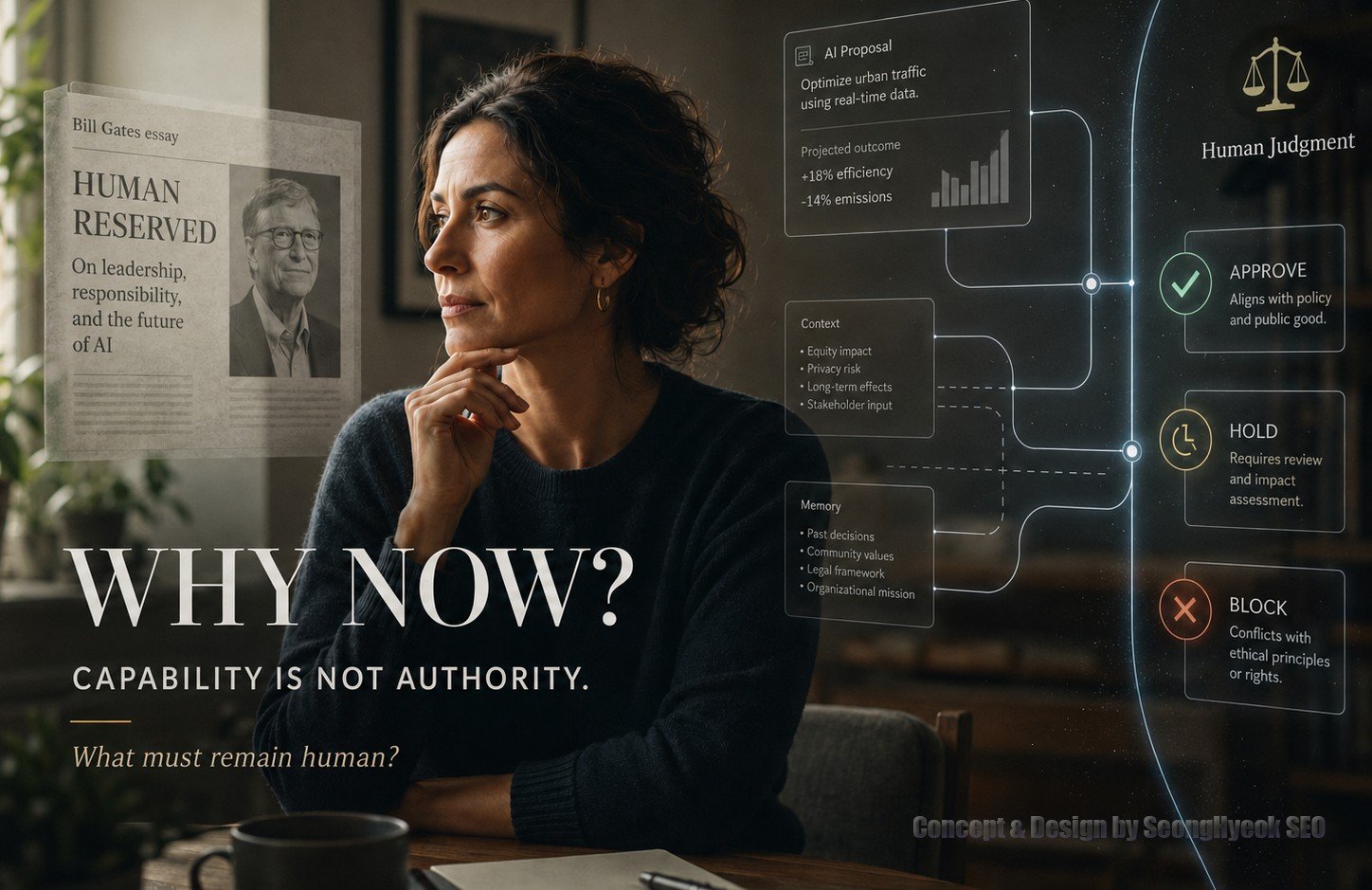
Why now?
Not because the idea is wrong.
Because the problem has been visible for some time.
AI used to speak. Now it is beginning to act.
For much of the generative AI era, our central question was whether AI could produce a good answer.
Could it write? Could it summarize? Could it reason? Could it create?
When the answer was wrong, the damage was often contained inside the conversation.
The model could apologize. The user could ask again. A bad sentence could be deleted.
But AI is moving beyond the screen.
It can call tools, schedule appointments, operate software, communicate with other systems, trigger transactions, and increasingly participate in decisions that have consequences outside the conversation.
As AI agents become more capable, the distance between a generated answer and a real-world action becomes shorter.
That changes the ethical problem.
An incorrect answer can often be corrected.
An executed action may not be reversible.
The moment AI moves from generating language to taking action, the question is no longer simply:
“What should AI say?”
It becomes:
“What should AI be allowed to do?”
And eventually:
“What must AI never be allowed to decide alone?”
This is where Human Reserved stops being only a social preference.
It becomes an architecture problem.
Why now?
The timing of Gates’ essay is worth noticing.
Human Reserved does not appear as a complete solution. It sits inside a much larger argument that society is not adequately prepared for the AI transition. Gates calls for new domestic and international structures to manage that transition, and says he plans to share more ideas in the coming months.
That makes the essay feel less like a sudden fear of AI and more like an attempt to move a problem onto the public agenda.
The important signal is not that Bill Gates has suddenly discovered that humans matter.
The signal is that one of the most influential figures of the software era now believes the gap between AI capability and society’s ability to govern it has become too large to ignore.
And once that gap becomes visible, Human Reserved immediately leads to a harder question.
A reserved space needs a boundary.
Gates’ metaphor works because a nature reserve is not merely a sentiment.
It has a boundary.
We decide that development may proceed on one side of that line and not on the other.
But AI is not land.
Its boundaries must operate inside systems.
A government can declare that certain decisions require human oversight.
A company can adopt a policy saying that some actions need human approval.
A regulator can require risk management, explanation, documentation, and supervision.
All of that matters.
But an AI system does not obey a principle simply because the principle appears in a policy document.
At the moment of execution, software still has to determine what happens next.
Does the system proceed? Does it pause? Does it ask again? Does it require approval? Does it transfer the decision to a person? Does it refuse to execute?
And if something later goes wrong, can we reconstruct why that path was chosen?
This is the point where a philosophical boundary becomes an operational one.
A reserved space needs a boundary.
And a boundary needs enforcement.
Human Reserved should not become a list of jobs.
It is tempting to solve the problem by naming occupations that should remain human: doctors, teachers, caregivers, judges, counselors, parents.
But such a list will become unstable.
AI may become extraordinarily useful inside every one of those domains.
It may help a doctor analyze information. It may help a teacher personalize educational material. It may help a caregiver notice changes that a tired human misses. It may help families communicate across distance.
The real question is therefore not whether AI belongs in those fields.
It probably will.
The harder question is:
Which authority inside those fields should remain human?
That changes the line completely.
Human Reserved should perhaps not be defined as a list of jobs.
It may need to be defined as a class of authority.
AI may recommend. AI may summarize. AI may detect. AI may prepare. AI may even act within clearly defined limits.
But some decisions may still require a human to retain final authority—especially when an action is difficult to reverse, affects another person’s rights, involves intimate information, or derives its meaning from a human relationship.
This is not an argument against automation.
Nor is it an attempt to preserve every existing human role simply because it exists today.
It is a distinction between assistance and authority.
A system may become better than a human at prediction, classification, or recommendation and still not acquire the legitimate right to make every consequential decision that follows from that prediction.
That is the distinction I keep returning to:
Capability is not authority.
An AI may become capable of doing something perfectly and still not possess the legitimate authority to do it.
Human oversight after execution is not really oversight.
Imagine that an autonomous system makes an irreversible decision at 2:00 a.m.
At 9:00 a.m., a human reviews the log.
A human was technically involved.
But the human did not supervise the decision.
The human reviewed the consequence.
Human oversight that happens after AI acts is not oversight.
It is review.
If human authority is to remain meaningful, systems must contain moments when they can actually stop.
Not because the model failed.
Not because the software crashed.
But because the system reached a boundary where human judgment is required.
The key is not the labels we use for those states.
The key is sequence.
The decision about whether to act must exist before the action itself.
Regulation is beginning to point in the same direction.
This is no longer only a philosophical debate.
South Korea’s AI Framework Act took effect on July 21, 2026. For high-impact AI, it requires measures that include risk management, arrangements for explaining important criteria behind results, user protection, human management and oversight, and documentation and retention.
The European Union has also entered the application phase of the AI Act. Most of the Act became applicable on August 2, 2026, while rules for Annex III high-risk AI systems are scheduled to apply from December 2, 2027.
That comparison matters.
Korea offers an early example of governance principles such as human oversight and documentation moving from policy language into operational obligations, while Europe is giving organizations more time to prepare for some of its most demanding high-risk requirements.
The legal language will differ across jurisdictions, but the underlying direction is becoming difficult to ignore.
When an AI system makes or executes an important decision, can we show what governed that decision?
Can we show where a human could intervene?
Can we show what was recorded at the time?
That last question matters.
A record reconstructed after an accident is not the same as a record created when the decision was made.
If governance exists only after execution, we may be able to explain a failure.
We may not have been able to prevent it.
This question is not entirely new to me.
While building and testing AI systems, I kept encountering a simple but uncomfortable moment: the model was ready to answer, but I was not always convinced that answering immediately was the right thing to do.
Sometimes the problem was not the quality of the answer.
The answer could be excellent.
The problem was whether the system understood enough about the person, the context, the relationship, the information boundary, or the possible consequence to act on that answer now.
That changed the question for me.
I stopped asking only:
“What should the AI say?”
I began asking:
“What should happen before it is allowed to say—or do—it?”
From there came harder questions.
When should it pause? When should it ask again? When should a person intervene? What should be recorded before anything difficult to reverse happens?
These can look like product-design questions.
They are really questions about authority.
That is why Gates’ essay caught my attention.
Many readers may see Human Reserved and think:
“Yes. Of course.”
I found myself thinking:
“Why now?”
Perhaps the answer is that, until recently, the boundary between humans and machines was largely a boundary of capability.
Machines could not do certain things, so humans did them.
That boundary is disappearing.
We now need another kind of boundary.
Not a boundary created by what machines cannot do.
A boundary created by what humans decide machines should not be allowed to do alone.
Human Reserved is not where AI lacks capability.
It is where capability must stop before authority begins.
The next AI debate may not be about intelligence.
For years, public discussion has focused on how intelligent AI will become.
Will it reach human-level reasoning? Will it surpass us? Will it replace jobs?
Those questions will continue.
But another question may prove more important:
Who retains authority when intelligence is no longer scarce?
That may be the deeper meaning of Human Reserved.
It is not only about protecting human employment.
It is about preserving human agency in a world where machines may become capable of performing almost every step of a task.
Capability alone cannot answer that question.
We will have to decide where legitimate authority remains human.
Then we will have to build systems capable of respecting that decision.
Bill Gates is asking society where the human boundary should be drawn.
It is an important question.
But immediately behind it is another one:
Where must that boundary live so that it can actually stop AI before AI crosses it?
Policy can declare a boundary.
Regulation can require one.
Organizations can define one.
But if an AI system can cross that boundary before a human can intervene, then the boundary exists only on paper.
The future of human-centered AI will not be decided only by what machines are capable of doing.
Nor only by what we tell them not to do.
It will depend on whether humans retain the practical authority to say:
This decision remains ours.