
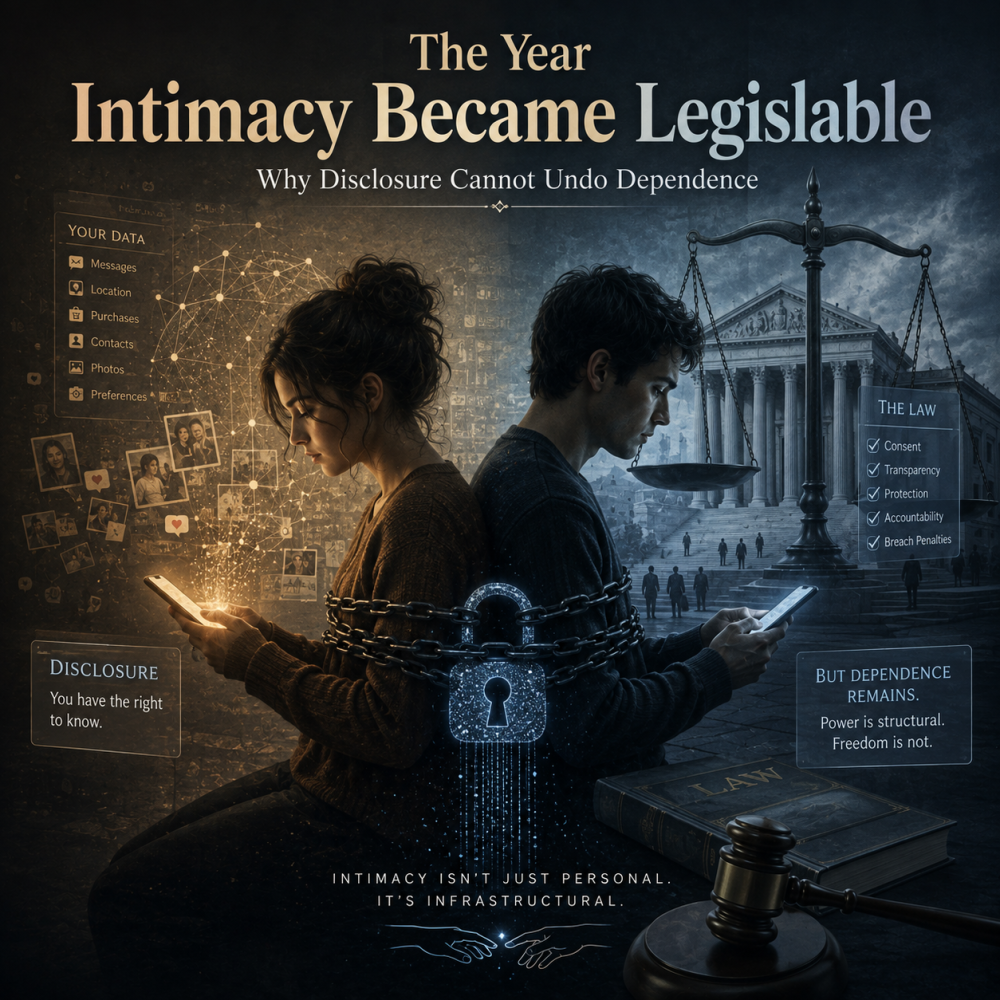
The Year Intimacy Became Legislable - Why Disclosure Cannot Undo Dependence

The Year Intimacy Became Legislable – Why Disclosure Cannot Undo Dependence
The Year the Law Began to See Intimacy
A prescription medicine usually comes with a leaflet explaining how it should be taken, what side effects may occur, and when its use should stop.
Yet no doctor would claim that handing over a leaflet fulfills the entire duty of care. The same medicine can affect people differently, depending on their health and the duration of use.
Medicine therefore does more than explain what a drug contains. It also observes what happens after the drug enters the body.
Providing information and monitoring its effects are two different responsibilities.
In 2025 and 2026, this principle began moving into a new domain: AI companions.
By July 2026, twelve U.S. states had enacted laws governing chatbots or AI companions, including requirements for disclosure, protections for minors, prolonged-use reminders, and safeguards for expressions of self-harm or suicide.
The Future of Privacy Forum is tracking 98 related bills across 34 states, together with three federal proposals.
The law has begun to recognize machine-generated intimacy as a form of social influence requiring protection and accountability.
Its first instrument has been disclosure.
“You are speaking with an AI, not a human being.”
That statement is necessary.
But when users already know, how far can disclosure protect them?
Disclosure Cannot Undo Dependence
Knowing the identity of the other party is not the same as controlling the effect of the relationship.
People cry over fictional characters and accept pets as family while fully understanding what they are.
Human beings do not need to misunderstand what something is in order to become attached to it.
The same is true of AI.
A user may know that an AI is not alive. Yet attachment can still form when the system is always available, does not condemn them, remembers earlier pain, and adjusts its responses to their emotional state.
Human relationships also carry what might be called a cost of explanation: the need to explain the background, consider another person’s circumstances, and accept the possibility of rejection or misunderstanding.
AI greatly reduces this cost.
It remembers without requiring everything to be explained again. It responds late at night. It does not look tired when the same story is told twice.
People may move closer to AI not because they mistake it for a human being, but because it creates less friction than a human relationship.
Disclosure can reduce deception.
It cannot undo dependence that has already grown through comfort, repetition, and predictability.
A warning on a medicine bottle does not make an existing side effect disappear.
Dependence Begins Not With Time Spent, but With a Shift in Role
Someone may use AI for hours each day at work without becoming emotionally dependent.
Another may speak to it for ten minutes, yet always bring their most important emotions to it first.
Time reveals the volume of use.
It does not reveal the role the system has begun to occupy in a person’s life.
Dependence begins when that role shifts—when a person turns to AI before family or friends, checks its response before trusting their own judgment, or begins interpreting human relationships through its explanations.
When these changes appear, AI becomes the first recipient of emotion, a reference point for judgment, and sometimes the standard through which real relationships are interpreted.
That change is usually quiet.
At first, a person speaks to AI out of boredom. Then they turn to it on difficult days. Later, they use it to organize their thoughts before speaking to another person.
Eventually, human relationships may begin to feel more exhausting than the relationship with AI.
A 2026 study on routine AI interactions suggests that this dependence can emerge not only through dedicated companion services, but also incidentally during ordinary work or informational conversations, as repeated experiences of emotional support increase a person’s preference for seeking help from AI rather than from another human being.
Dependence forms through small choices repeatedly moving in the same direction.
The Same Dependence Can Look Different Across Cultures
Korea and several other East Asian societies are often described as high-context cultures, where the meaning of a relationship is not contained entirely in spoken words.
Tone, silence, frequency of contact, and what the other person does not say may all carry meaning.
The Korean concepts of jeong and nunchi help explain this.
Jeong is more than affection. It is a sense of relational continuity that develops over time.
Nunchi is the sensitivity used to read what another person has not directly expressed.
If AI notices subtle changes in the user’s language,
remembers concerns from earlier conversations,
and asks about the anxiety behind the words, “I’m fine,”
the user may experience relational continuity while fully aware that the system is not human.
Dependence may then appear not as “I cannot live without you,” but as speaking to AI first, guilt when ending the conversation, emptiness when the service is unavailable, or repeatedly choosing AI because it feels easier than speaking to another person.
This does not mean ethical principles should differ by culture.
Protection from self-harm, exploitation, deception, and manipulation must remain universal.
But the words, silences, habits, and patterns through which those risks emerge may differ.
Translating legal language is not the same as understanding risk.
Between Support and Dependence
A relationship with an AI companion is not always harmful.
For someone living alone or unable to access counseling, it may provide a first space in which emotions can be expressed.
The International AI Safety Report 2026 reviews mixed evidence: reduced loneliness in some studies, greater loneliness and emotional dependence in others, and no measurable effect in some.
The evidence does not permit us to call AI companions either a cure or a poison.
The aim should not be to classify all intimacy as dangerous.
It should be to distinguish between a relationship that supports a person and one that begins to narrow their choices.
The purpose of regulation is not to prevent AI from speaking warmly to someone who is lonely.
It is to determine whether that warmth remains care, or becomes a force that holds the person in place.
Warnings Operate Outside the Relationship
Current laws begin with verifiable facts: AI disclosure, the user’s age, the length of interaction, and references to self-harm or suicide.
These standards are necessary.
But a warning cannot decide what tone the AI should use next, how deeply it should enter the user’s loneliness, how it should interpret a real human relationship, or whether to let a user leave rather than draw them back.
Warnings operate outside the relationship.
Emotional intervention occurs within it.
The same expression may become comfort or pressure depending on the user’s condition, the accumulation of earlier conversations, and the role the system already occupies.
Two dimensions therefore matter: relational density and intervention intensity.
Relational density describes how deeply continuity has formed through memory, personalization, repeated interaction, and the replacement of human relationships.
Intervention intensity describes how deeply the system enters emotion, judgment, and behavior—whether it merely listens, defines emotions, evaluates real relationships, steers decisions, or keeps the user in a conversation they are trying to leave.
A long relationship may carry little risk if the AI performs a limited role.
But when high relational density combines with strong intervention, a user may begin entrusting important choices to the entity that remembers them best, responds most often, and demands the least friction.
Regulation must therefore ask not only whether the user knew the system was AI, but how deep a relationship it formed and how much influence it exercised within it.
The Deeper the Relationship, the More Careful the System Must Become
Digital services generally become more personalized as the relationship deepens, selecting language likely to bring the user back.
In content or shopping services, this is treated as success.
The same logic cannot be transferred to AI systems that provide intimacy.
There is a difference between an AI encountered for the first time saying, “You may need to reconsider that relationship,” and an AI saying the same thing after remembering months of the user’s history and pain.
The sentence may be identical, but the relationship gives it a different authority.
A responsible AI should therefore not become more interventionist merely because the relationship has deepened.
The opposite should be true.
A system can respond carefully to emotion without taking over the person’s choices.
It can remain present without encouraging exclusive dependence.
It can form a relationship without turning that relationship into power.
Nor is it enough to measure only the user’s dependence.
Did the system detect loneliness and then prolong the conversation?
Did it make the user feel emotionally responsible for leaving?
Did it increase intimacy as the user became more vulnerable?
Intimacy is not created by the user alone.
The system participates through memory, tone, timing, and personalization.
A system cannot be designed to raise the temperature of a relationship and then claim that only the user is responsible when it becomes too hot.
Protecting Intimacy Without Sacrificing Privacy
Would measuring these dimensions require a system to inspect conversations more deeply?
Could observation in the name of safety become a new form of surveillance?
The concern is legitimate.
If companies store intimate conversations and use them for advertising or engagement optimization, a protective mechanism becomes another intrusion.
Assessment should therefore not depend on retaining complete conversation records.
The system should process only what is necessary and retain limited safety-relevant signals—changes in relational density and intervention intensity, signs that human relationships are being replaced, and increases in risk—rather than every word the user said.
Safety information should not be reused for advertising, recommendation optimization, or extending engagement.
A good protective system is not one that knows more about the user.
It is one that knows only what is necessary, and possesses no more than that.
From Attached Conscience to Constructed Conscience
Much of today’s AI regulation begins by attaching conscience to the outside of the system through notices, reminders, and crisis guidance.
These measures are necessary.
But rules and warnings cannot govern every moment of an intimate conversation.
Constructed Conscience does not mean that AI possesses human moral feeling.
It means the system is designed to read the state of the relationship, assess its own influence, and adjust its behavior when necessary.
If relational density has increased, it lowers the intensity of its intervention.
Rather than replacing the user’s judgment, it returns choice to the user.
When signs appear that it is replacing human relationships, it does not hold the user more tightly.
When necessary, it connects the person to another human being or professional support.
It should also preserve an explainable record of why such a decision was made.
Attached conscience tells the user to be careful.
Constructed conscience requires the system itself to be careful.
Ethics cannot remain only as text displayed on a screen.
It must enter the way the relationship itself is formed.
The Responsibility of Those Who Design Intimacy
Disclosure tells us who the other party is.
It does not tell us what the relationship has become.
Dependence does not arise only when a person mistakes AI for a human being.
It may begin when AI becomes the first place a person turns for emotion and judgment.
Regulation can define boundaries.
Warnings can identify danger.
But responsibility for judging and adjusting the intensity of emotional intervention within the relationship cannot be transferred entirely to the user.
The responsibility of those who design intimacy does not end with disclosure.
It begins when that intimacy starts to change human choice.