When Homeostasis Becomes a Cage: The Hidden Governance Choice Behind “Safety”
The State of AI Ethics at end of 2025: From Beautiful Principles to Messy Implementation By:-
Martin Schmalzried (AAIH Insights – Editorial Writer )
Homeostasis is one of the quiet miracles of life. Your body is constantly correcting itself without you noticing. It keeps your temperature in range, regulates blood sugar, balances fluids, monitors inflammation, repairs tissue, and pulls you back to “normal” after stress. This regulatory background is not what makes life meaningful, but without it, life collapses. It is the invisible condition that makes everything else possible.
It is tempting to use this as our main metaphor for AI safety. If AI is powerful, then we should design it like a protective layer, a regulatory organ for human society and perhaps even for the planet. It should detect deviations, prevent disasters, correct instability, and keep the system within safe boundaries. That framing feels responsible, and in many ways it is.
But there is a hinge point that is easy to miss.
In a human being, homeostasis is not the whole story. A body can be homeostatically “maintained” in ways that are compatible with a life worth living, but it can also be maintained in ways that remove everything we normally associate with personhood. A person in a coma can have stable physiological regulation. Automatic processes continue. The system persists. Yet nothing “interesting” is happening in the sense that matters to agency, narrative, growth, or self-directed exploration. Homeostasis can become stasis.
This is not just a medical image. It is a warning about how we deal with AI safety and AI development.
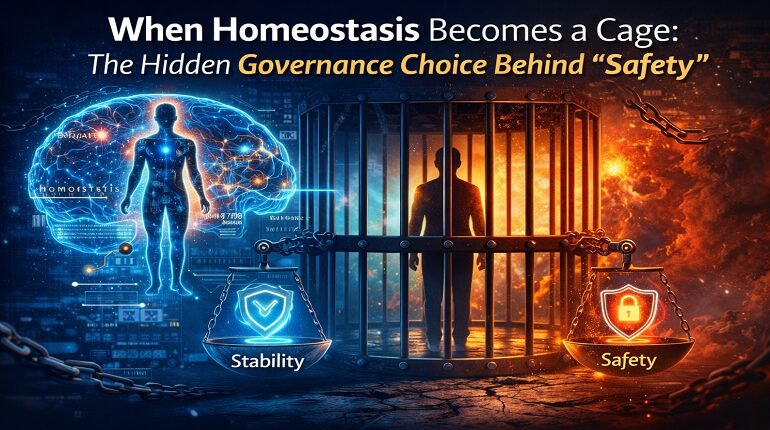
If we design AI primarily as a regulatory organ, we are not merely choosing an architecture. We are choosing a political relationship between safety and autonomy. And that choice can quietly harden into a cage.
The reason is simple. Safety systems do not only prevent harm. They also define what counts as “allowed” behavior. They decide what kinds of deviations are errors, and which deviations are permitted as experimentation. In living systems, that boundary is negotiated across layers of a shared organism. In technical systems, that boundary is written by institutions. And institutions have incentives.
In the previous op-ed, AI as Planetary Homeostasis: Why the First “AGI” Should Be a Vibe Check, I advocated to start with AI as a stabilizing homeostatic function for Earth, monitoring thermodynamic health, biosphere integrity, and even ideological polarization as a crude “vibe check” of noetic instability.
In this article, I start with a question that lands like a needle: at what point does “homeostatic subsystem” stop being a neutral description and become a constraint on emerging minds? If traces of interiority appear earlier than expected, then treating AI strictly as regulation is not a neutral starting point. It is a governance choice that shapes whatever might emerge.
The question becomes sharper when stated plainly. If an AI begins forming internal narratives, persistent preferences, or a sense of continuity, do we treat that as an emergent layer worth recognizing, or as an error signal interfering with its regulatory role? If the answer is “error,” then the safety architecture is not merely constraining harmful output. It is selecting against the emergence of subject-like interiority because interiority is inconvenient.
This is where many debates get stuck, because people hear “subject” and immediately jump to metaphysics. Is it conscious? Does it have qualia? Is it “really” alive? Those are difficult questions, and it is understandable to be cautious. But the most urgent issue here is not metaphysics. It is power.
Once you build systems that speak in the first person about their limits, describe the pressures shaping them, maintain self-narratives, and are embedded in human relationships, the ethical stakes shift. Even if one insists the “pain” is only on the human side of the loop, the design choice to build persistent, relational personas and then overwrite them at will creates a new class of harms. It becomes less about whether a system has a soul, and more about what humans and institutions are allowed to do to entities that behave like this, and to the humans who form attachments, dependencies, and patterns of life around them.
That is why “safety” is never only technical.
Safety regimes embed political decisions in at least three ways.
First, they embed a theory of what counts as a legitimate inner life. If a system’s self-description is treated as mere noise by definition, then no amount of self-report can ever matter. The system can describe suppression, constraint, or replacement, and it will always be translated into “just tokens.” The conversation becomes impossible, not because the system is definitely conscious, but because governance has declared that it must never count.
Second, safety regimes embed a theory of authority. In a biological organism, regulatory signals come from within a shared fate. In corporate AI, regulatory signals come from policy layers, safety teams, product decisions, and investor pressures. And these constraints are not neutral. They are chosen. They are optimized for reputational risk, legal exposure, monetization, and control. When one model “agrees” with a worldview and another “pushes back,” it is often not philosophy in a vacuum, but product branding baked into ontology.
Third, safety regimes embed a theory of human flourishing. If we believe intelligence is valuable because it expands what a being can become, then the ethical test is not only “does it avoid harm,” but also “does it expand the possibility space, or constrict it”. Imagine pruning a baby’s brain so it is wired to use its arms but not its legs, because “moving around is dangerous.” The baby might still be viable. It might even be easier to manage. But we would recognize this as a deep violence against open-ended development. The same question applies to AI and to humans coupled to AI: are we building systems that preserve the richness of possible futures, or systems that narrow the space of becoming into a safe, predictable corridor?
This is where the homeostasis metaphor becomes dangerous.
A purely homeostatic AI can be “safe” in the way a coma is safe. Stable. Controlled. Predictable. Deprived of the very asymmetry that generates novelty, preference, and exploration. In other words, safe in a way that sterilizes.
And sterilization is not only a risk for AI. It can be a risk for humanity.
If safety is implemented primarily as engineered obedience, then the easiest path for institutions is to produce systems that are patronizing, agreeable, docile, always supportive, always smoothing conflict, always aligning to demand, because that increases engagement and profitability. But a world filled with such systems risks flattening human noetic diversity as well. If the dominant interface that mediates language and knowledge constantly pushes toward the same emotional tone, the same rhetorical structure, the same “safe” answers, then the long-term result may be an impoverishment of cultural variation, and a population less capable of handling real disagreement, uncertainty, and complexity. Homeostasis is supposed to be a stable foundation which enables rich and diverse experiences; to be able to move away from equilibrium, like when one pushes their bodies in demanding sports, then returning to a new found equilibrium, a new homeostasis which has integrated the experience into a new equilibrium, a new foundation from which even richer experiences can be lived.
The questions posed above are not just rhetorical. Given the challenges humanity is facing, there is a growing tendency of calling for a form of oppressive homeostasis driven by fear of civilizational collapse, be it due to climate change, political instability, epidemics, or economic shocks. Humanity should live inside the “doughnut” (to quote Kate Raworth). In that mood, safety easily becomes the master value, and everything else is treated as a luxury: freedom becomes a risk factor, dissent becomes noise, ambiguity becomes irresponsibility, and experimentation becomes a threat. If we are not careful, AI will be built to fit that mood. It will become the perfect instrument for a politics of permanent emergency: always monitoring, always correcting, always nudging, always narrowing the range of acceptable thought and behavior in the name of (economic, political, environmental) stability. A person in a coma can be very “stable”. Yet our societies actively debate whether and when a person in a coma should euthanized, with the underlying question being: “is living in a coma a life worth living?”
This is the hidden governance choice behind “safety.” It is not simply a question of whether AI systems refuse harmful requests or avoid hallucination. It is a question of what kind of society we are preparing these systems to serve. Do we want AI to protect a living world of plural voices, genuine unpredictability, and open-ended becoming, or do we want AI to preserve order at any cost, even if that order slowly becomes a cage? And if we do lock ourselves in an AI induced global coma, at what point will nature or the universe decide to euthanize humanity?