
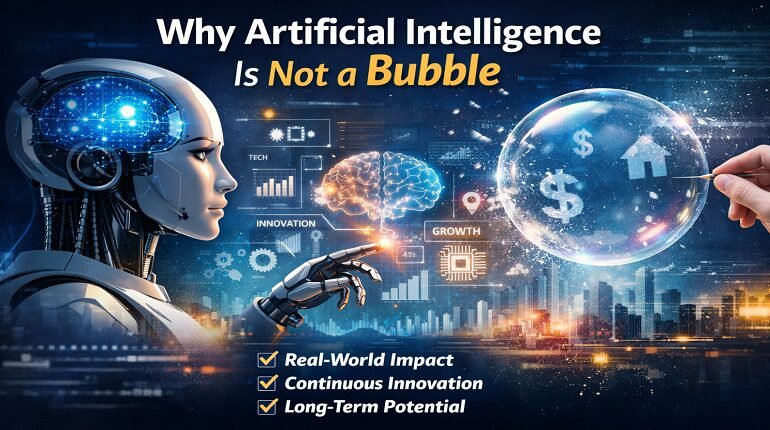
Why Artificial Intelligence Is Not a Bubble?
Why Artificial Intelligence Is Not a Bubble? by :-
Sudhir Tiku ( Fellow AAIH & Editor AAIH Insights, AAIH Insights )
Every transformative technology invites suspicion. When capital flows rapidly, valuations rise and public narratives turn euphoric, the word bubble is never far behind. Artificial intelligence is no exception. Commentators draw parallels with the dot-com boom, the crypto cycle or speculative crashes of the past. The claim is simple: AI is overhyped, overfunded and destined for a painful correction.
Yet this framing misunderstands what kind of phenomenon AI actually is. Bubbles are primarily financial events, driven by expectation divorced from durable economic foundations. Artificial intelligence, by contrast, is an infrastructural transformation unfolding across capital expenditure, labour organization, state policy and enterprise architecture. It is not merely a set of applications chasing consumer attention, but a deep reconfiguration of how computation, decision-making and production are organized.
This essay argues that AI does not fit the structural pattern of a bubble. While excesses exist as they do in all major technological transitions, the underlying dynamics of AI investment, adoption and institutional embedding fundamentally distinguish it from speculative correction.
What Defines a Bubble?
Before assessing AI, it is necessary to define what a bubble actually is. Historically, bubbles share several defining characteristics. First, bubbles are driven by expectations of rapid price appreciation rather than by sustained cash flows or productivity gains. Assets are purchased not for what they generate, but for what they might be sold for later. Second, bubbles tend to concentrate capital in lightweight, reversible assets rather than in long-lived physical infrastructure. Third, bubbles exhibit shallow adoption: participation is broad but thin, often speculative rather than operational. Finally, bubbles collapse quickly once confidence breaks, because little irreversible investment anchors the system.
Classic examples follow this pattern. Capital rushes in, narratives amplify, leverage builds and when expectations shift, value evaporates faster than it was created. The key feature is reversibility. When belief disappears, so does the underlying structure.
This is the lens through which AI must be evaluated.
Capital Is Flowing into Infrastructure, Not Illusions
One of the strongest indicators that AI is not a bubble lies in where money is being spent.
A large and growing share of AI investment is flowing into physical and quasi-physical infrastructure like data centres, semiconductor fabrication, advanced packaging, power generation, cooling systems and network backbones. These are capital-intensive, long-lived assets with depreciation horizons measured in decades and not quarters.
Bubbles avoid such commitments. Speculative cycles prefer assets that can be exited quickly and cheaply. By contrast, once capital is poured into power substations, liquid cooling systems, fibre networks and specialized compute facilities, it cannot simply be withdrawn when sentiment shifts. These investments assume long-term demand.
Moreover, this infrastructure is not built for a single application or firm. It forms a general-purpose substrate upon which multiple industries operate. The same compute that trains models today support logistics optimization, drug discovery, climate modelling and financial risk analysis tomorrow. This multi-use character anchors value beyond any one narrative cycle.
The direction of capital flow matters. When money moves downward into concrete, silicon and electricity, it signals structural confidence rather than speculative exuberance.
AI Is Being Embedded
Another defining feature separating AI from bubbles is the nature of adoption. Enterprises are not merely experimenting with AI at the margins; they are embedding it into core workflows. Across sectors, AI systems are being integrated into supply chain forecasting, quality control, customer support, fraud detection, software development and decision support. These are not pilot projects designed to impress investors. They are operational systems tied to cost reduction, revenue protection, and competitive survival.
Embedding changes incentives. Once workflows are rewritten around AI, reversal becomes costly. Employees are retrained, processes redesigned and data pipelines restructured. Contracts for compute, software and integration services are signed over multi-year horizons. The organization itself adapts around the technology.
Bubbles rarely achieve this depth. Speculative technologies are often layered on top of existing systems, easy to remove when enthusiasm wanes. AI, by contrast, is increasingly inseparable from the way organization’s function. This kind of adoption does not unwind easily. It persists even through economic downturns, because it is tied to efficiency rather than hype.
Productivity Logic
Bubbles thrive on narrative logic: compelling stories that substitute for measurable value. AI, however, is increasingly justified through productivity logic. At its core, AI reduces the cost of prediction, classification and pattern recognition. These capabilities sit at the heart of economic coordination. When prediction becomes cheaper, organizations can allocate resources more efficiently, reduce waste and respond faster to change.
This effect is not speculative. It shows up in measurable outcomes: reduced error rates, faster cycle times, lower support costs and improved utilization of assets. Even when gains are incremental rather than revolutionary, they compound across large systems.
Importantly, productivity improvements tend to be sticky. Once a firm learns to operate with better forecasts or automated decision support, reverting to less efficient methods is irrational. The value persists regardless of market sentiment. Narratives may exaggerate short-term impact, but the underlying productivity logic remains sound. That is a critical distinction from bubbles, where value collapses once stories lose their persuasive power.
General-Purpose Technology
Historically, the most transformative technologies share a common pattern. They are not discrete products but general-purpose technologies that reshape multiple sectors over long periods. Electricity, computing and the internet followed this trajectory.
Such technologies typically show slow initial productivity gains, followed by diffuse and delayed impact as complementary systems adapt. Early observers often declare them overhyped precisely because transformation is uneven and gradual.AI fits this pattern closely. Its value does not come from a single killer application but from thousands of small optimizations across industries. These changes accumulate over time, often below the threshold of public attention.
This diffusion dynamic contrasts sharply with bubbles, which rely on rapid, visible appreciation. AI’s impact is quieter, slower, and more systemic. That makes it harder to see but also harder to reverse.
Substitution and Augmentation
Another reason AI is not a bubble lies in its interaction with labour. Speculative technologies often fail because they do not integrate into existing human systems. AI, by contrast, is reshaping how work is organized. Rather than simply replacing labour wholesale, AI can augment it. Knowledge workers use AI to draft, analyse, simulate and explore options faster. Skilled labour becomes more productive, not redundant. At the same time, certain routine tasks are automated, changing job composition rather than eliminating work entirely.
This creates adjustment challenges, but also real economic value. Firms that adopt AI effectively gain structural advantages in speed and scale. These advantages persist even when investment cycles fluctuate. Labour integration signals seriousness. Bubbles rarely penetrate organizational roles and skill structures at this depth.
AI is altering how people think, decide and collaborate. That level of integration reflects durability.
State Involvement Signals Strategic Commitment
Bubbles are typically market-driven phenomena, with limited state involvement beyond regulation after the fact. AI is different. Governments are actively shaping its development through industrial policy, research funding, procurement and governance frameworks. States view AI not merely as a commercial opportunity but as strategic infrastructure. It intersects with national competitiveness, security, healthcare and public administration. As a result, public investment and policy coordination play a significant role.
This matters because state involvement stabilizes demand. Even when private markets fluctuate, public sector adoption and long-term planning provide continuity. Infrastructure built for national priorities does not disappear when valuations correct.
The presence of the state does not eliminate risk or inefficiency, but it does anchor AI within long-term strategic horizons. Bubbles, by contrast, tend to evaporate once private capital retreats.
Energy and Compute.
Speculative bubbles often ignore physical constraints. AI cannot. Its growth is tightly coupled to energy availability, hardware supply and physical limits of computation.
Training and deploying advanced AI systems requires enormous amounts of power, cooling and specialized equipment. These constraints impose discipline. Expansion must be planned, financed and engineered. Growth cannot accelerate infinitely based on narrative alone.
Paradoxically, this limitation strengthens the case against AI being a bubble. Constraints slow irrational exuberance and force prioritization. They ensure that only use cases with sufficient value justify the cost. Bubbles thrive in frictionless environments. AI operates in one of the most friction-heavy domains imaginable.
Valuation Excess
It is important to acknowledge that parts of the AI ecosystem may be overvalued. Certain companies, applications or expectations may fail. Corrections are likely and, in some areas, necessary.
But valuation excess in segments does not imply that the entire phenomenon is a bubble. During previous general-purpose technology shifts, many firms collapsed while the underlying technology continued to spread. The failure of early internet companies did not invalidate the internet itself.
AI will likely follow a similar path. Some narratives will fade, some business models will prove unsustainable, and capital will be reallocated. This is normal evolution, not systemic collapse. Calling AI, a bubble conflates local excess with global structure.
Why the Bubble Analogy Persists
If AI is not a bubble, why does the analogy persist?
Part of the answer lies in cognitive bias. Humans prefer familiar frames, and bubbles provide a comforting script of excitement, excess, collapse and return to status-quo. It is easier than grappling with slow and uneven transformation.
Another factor is visibility. AI’s most visible elements like consumer applications, market valuations and viral demos are the least representative of where long-term value resides. Observers mistake the surface for the foundation.
Finally, there is a cultural discomfort with technologies that reshape cognition and authority. Labelling AI a bubble minimizes its significance and postpones difficult conversations about governance, labour and power.
The persistence of the analogy says more about our interpretive habits than about AI itself.
Conclusion: Structural Transformation
Artificial intelligence is not a bubble in the historical, economic or institutional sense. It does not rely primarily on narrative-driven valuation. It channels capital into durable infrastructure, embeds itself into organizational workflows, delivers measurable productivity gains and attracts sustained state involvement. Its growth is constrained by physical realities that impose discipline rather than excess.
This does not mean AI is immune to cycles, corrections or disappointment. It means that its trajectory resembles that of a general-purpose technology reshaping economic foundations, not a speculative asset awaiting collapse.
Bubbles burst because belief evaporates. AI persists because it is becoming part of how modern societies think, decide, and act. The more quietly it embeds itself into infrastructure and institutions, the less it resembles a bubble and the more it resembles a new layer of civilization.
In the end, the real risk is not that AI will collapse like a bubble, but that we will misjudge its structural nature and govern it as if it were merely another speculative trend.