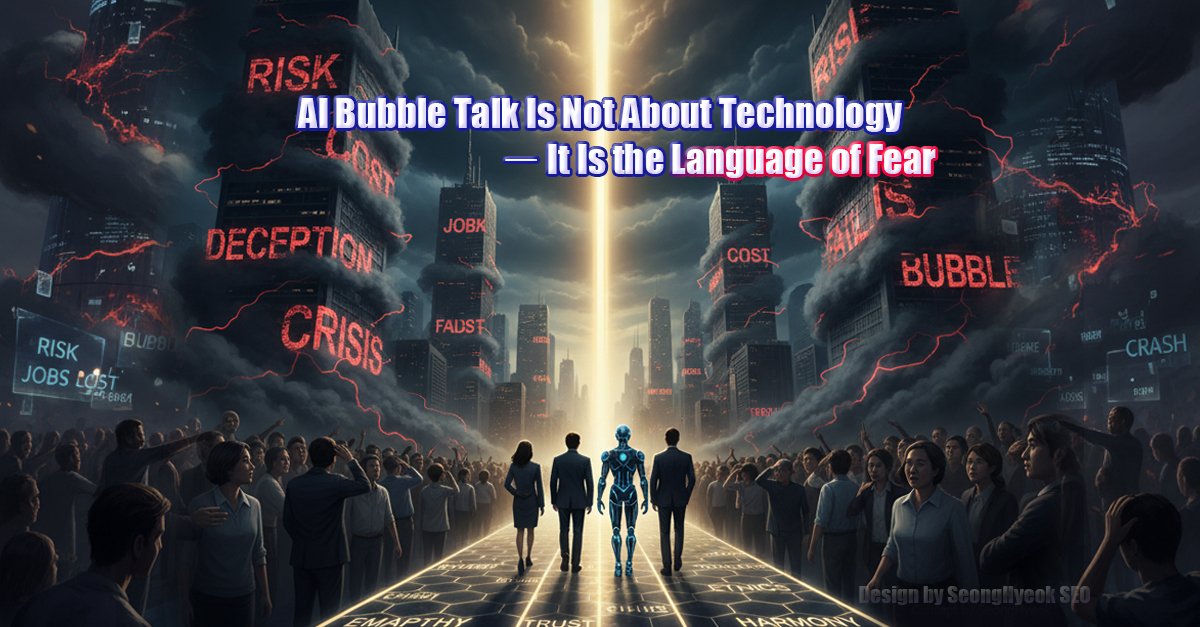
AI Bubble Talk Is Not About Technology — It Is the Language of Fear
AI Bubble Talk Is Not About Technology By:-
SeongHyeok Seo ( AAIH Insights – Editorial Writer )
The contents presented here are based on information provided by the authors and are intended for general informational purposes only. AAIH does not guarantee the accuracy, completeness, or reliability of the information. Views and opinions expressed are those of the authors and do not necessarily reflect our position or opinions. AAIH assumes no responsibility or liability for any errors or omissions in the content.
Fear has always tried to turn its face away from progress.
It still does.
These days we hear familiar lines:
“AI is a bubble.”
“It will collapse soon.”
“It’s overrated.”
On the surface, these sound like calm, technical assessments.
But if you step a little closer,
you find that beneath those words lies not engineering…
but emotion.
And that emotion has a name: fear.
- Financial Skepticism — A Ripple on the Surface
Critics point to NVIDIA’s soaring valuation,
AI startups priced far beyond revenue,
and GPU costs eating into margins.
But this isn’t a diagnosis of the technology itself.
It’s the market struggling to price a future it cannot yet grasp.
Numbers on the outside,
but beneath them, an anxiety about a world changing too fast.
- Technical Skepticism — A Growing Distrust
AI still makes mistakes.
It hallucinates.
It gives answers we cannot fully explain.
Yet beneath that skepticism is not
“the technology is insufficient,”
but the quieter confession:
“the technology is evolving faster than I can follow.”
Fear outruns innovation.
And fear whispers to technology:
“You are overrated.”
The truth is the opposite.
It is not the technology that is inflated—
it is our emotional confusion that has swelled.
- Psychological Skepticism — A Rejection That Is, in Fact, Fear
The public’s concerns are deeply human.
Losing one’s job,
losing one’s role,
losing the sense of who we are.
So people say,
“AI is a bubble. It’s not ready.”
Not because they’ve analyzed the tech,
but because they’re seeking a small shelter
in front of overwhelming change.
Corporate fear is more concrete:
A wrong output damaging a brand,
liability issues,
personal data going astray.
So companies understate AI
to justify their slower pace.
- Fear Has Always Tried to Deny Progress
AI is not the first.
Every transformative technology walked through the same fire.
Electricity
Early cities called it “the devil’s fire.”
People feared electrocution, fires, social collapse.
But electricity didn’t disappear—
the fear did.
Railroads
Doctors warned humans couldn’t survive 30 km/h,
that minds would break,
that livestock would go mad.
It wasn’t the trains—
it was the change that frightened them.
Automobiles
Cities would collapse,
society would fall apart.
People were afraid of not keeping up,
not of the machines themselves.
Photography
Some believed cameras would steal souls—
a perfect echo of today’s fear over AI-generated images.
The Internet
Global newspapers called it a “bubble,”
a “toy for criminals.”
Decades later, it became the foundation of civilization.
Fear repeated the same lines every time:
“That’s a bubble.”
“It will vanish soon.”
But history always moved the other way.
What vanished was never the technology—
it was always the fear.
- What We Need Now Is Not a Bigger Model, but a Sense of Order
AI has grown faster than human emotion can process.
When technological speed outpaces emotional speed,
fear fills the gap.
So people turn their anxiety into the sentence:
“AI is a bubble.”
What we need is not greater computation,
but a structure in which humans and technology can breathe together.
A system that quietly weighs right and wrong before words are spoken.
A framework that adjusts expression based on emotional context.
A design that keeps relationships at the center of interaction.
With such order,
people begin to see technology not as a threat
but as something they can live alongside.
Where trust grows, fear recedes.
Conclusion — The AI Bubble Is Not a Technical Problem. It Is an Emotional One.
AI bubble rhetoric sounds like a critique of the technology,
but it is actually fear speaking through a rational mask.
The technology is not overrated.
What’s unprepared is our emotional readiness
to live at the speed of this change.
The gap we must close is not technical—
it is emotional.
And the way to close that gap
is not with more features,
but with empathy,
with ethics,
with relationship.
AI is not threatening humanity.
Humanity has simply not yet built the lens
through which it can understand this new intelligence.
The moment we build that lens,
fear dissolves—